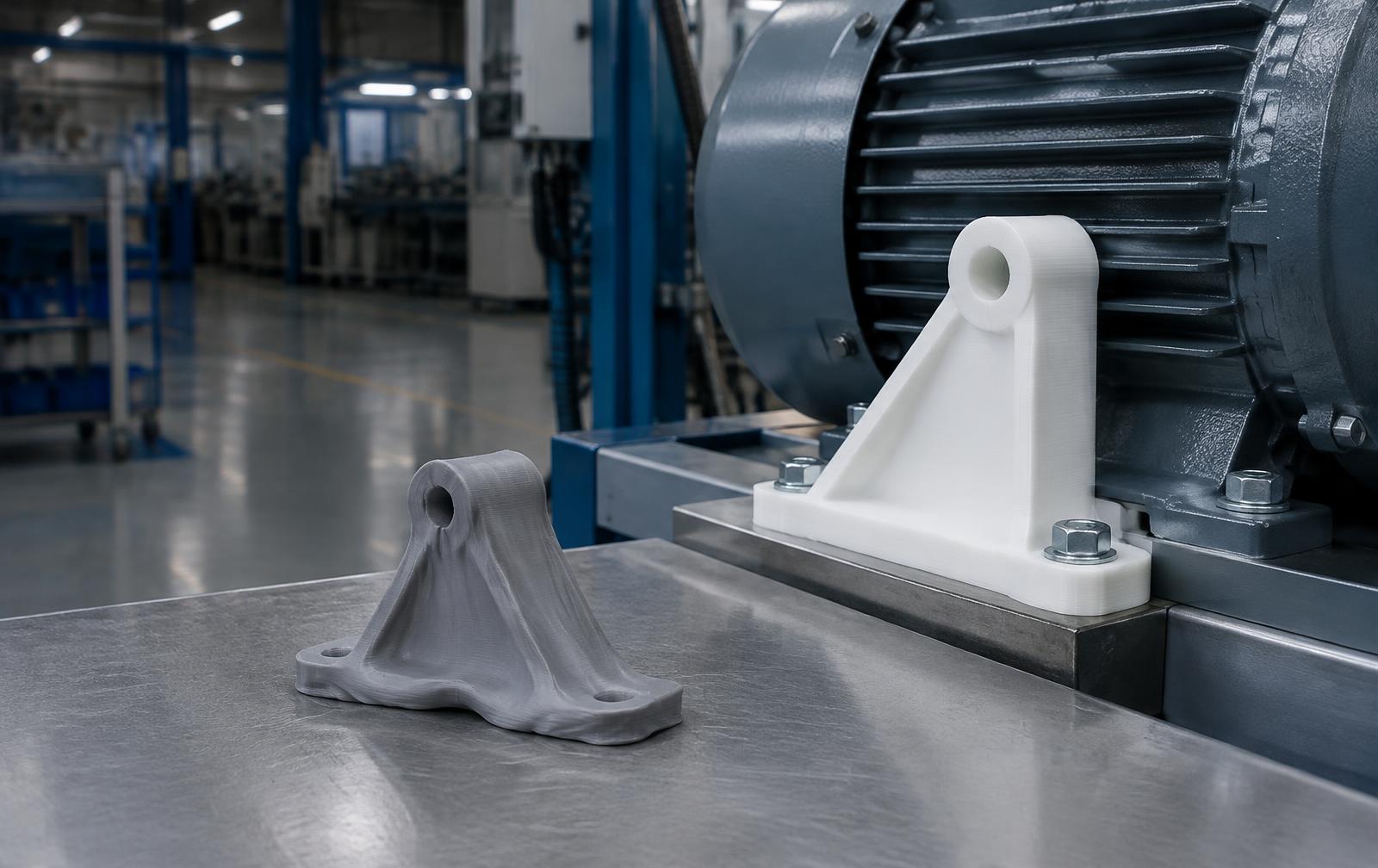
When a part softens in ABS, polycarbonate is the usual next step. Our polycarbonate 3D printed parts are rated to about 138°C, held to ±0.15mm per 100mm and printed up to 914 × 609 × 914mm in a single piece. Before anything prints, an engineer checks the load, heat and chemicals the part will face. Send your file for a free online polycarbonate 3D printing quote.
Rated to about 138°C±0.15mm/100mmUp to 914mm single pieceEngineer file checkNo minimum orderConfidentialShipped Australia-wide.
We print finished polycarbonate parts from your files. We don't cut polycarbonate sheet, sell filament or build computers.
What Is Polycarbonate 3D Printing?
Polycarbonate, or PC, is a tough, heat-resistant engineering thermoplastic. It's the plastic family behind machine guards, headlamp lenses and electrical housings. In 3D printing, PC filament is melted and laid down layer by layer on industrial FDM equipment. The heated build chamber keeps the part dimensionally stable as it cools.
The finished part holds its shape to about 138°C, well above ABS or ASA. It is strong and stiff, insulates electrically, and can be drilled and tapped. Three limits matter: it prints in white only, it isn't rated for long-term sun exposure, and a printed part is far less impact resistant than moulded polycarbonate sheet.
Quantix 3D Printing runs polycarbonate 3D printing Australia-wide as one national PC 3D printing service, with the same team, build envelope and tolerance whichever state or territory you order from.
Polycarbonate has a reputation built on safety glasses and riot shields. A 3D printed part earns some of that reputation, but not all of it.
So, is 3D printed polycarbonate strong? For a printed plastic, yes. Here's what changes when it's built in layers:
Impact.On standard notched impact tests, moulded polycarbonate is roughly eight to eleven times tougher than a printed PC part. A printed part still yields before it breaks, but it won't behave like a sheet guard.
Direction.On the published datasheet for this class of FDM polycarbonate, a test bar pulled along its layers reaches about 57 MPa, and about 36 MPa when pulled across them. We orient every part so the main load runs along the layers, and tell you if the geometry won't allow it.
Heat.This is where printing gives up very little. A printed PC part keeps almost all of the material's heat resistance, which is the main reason to choose it.
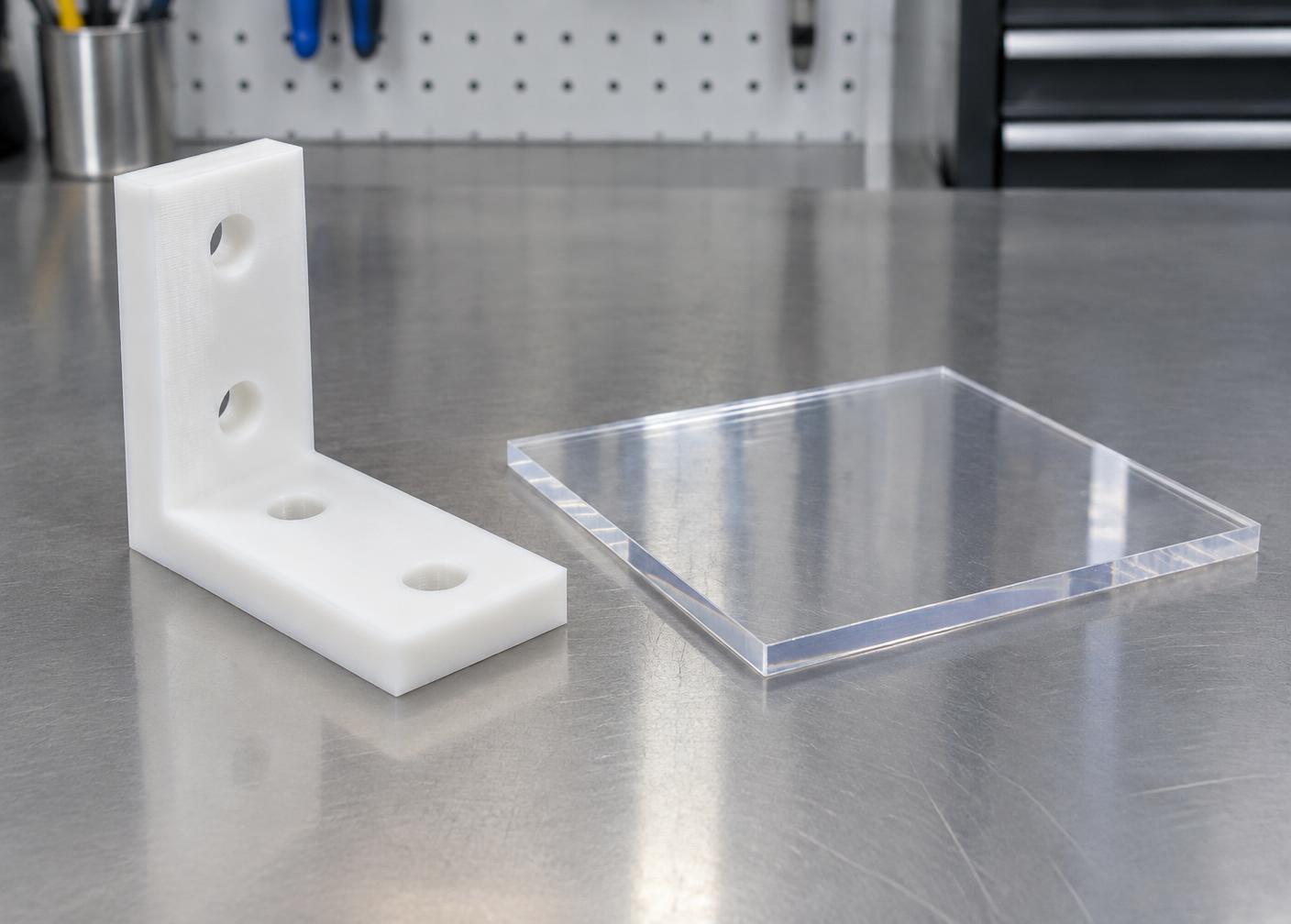
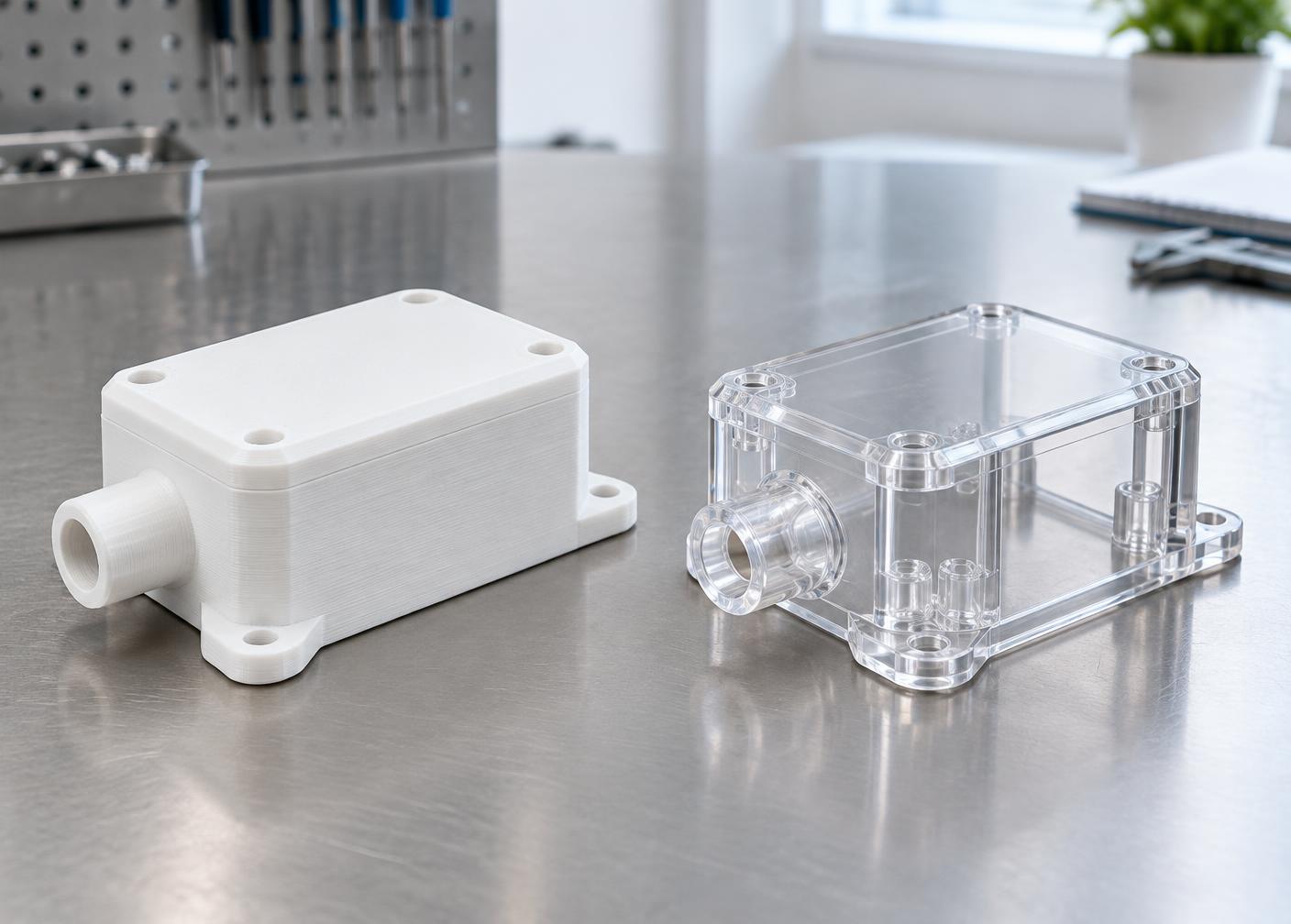
Many requests for clear polycarbonate 3D printing start with a drawing that says "PC" and a part that needs to be see-through. Our polycarbonate prints in opaque white. Layered FDM can't produce a glass-clear part in any material, and resins sold elsewhere as "polycarbonate-like" are photopolymers that only imitate PC.
When a part has to be see-through, we use these materials instead:
Material
Process
Clarity
Heat rating
Max single piece
Choose it for
Transparent Resin
SLA
Clear after finishing
~60°C
600 × 600 × 400mm
Lenses, light guides, flow and fit models
Transparent Acrylic
Material jetting
Clear
~80°C
284 × 184 × 203mm
Small, detailed clear parts that run warmer
Vero Clear (High-Detail)
PolyJet
Clear
~70°C
250 × 250 × 200mm
Fine-detail clear prototypes
Polycarbonate
FDM
Opaque white
~138°C
914 × 609 × 914mm
Heat and load, where seeing through doesn't matter
If you need both clarity and real heat resistance in one part, tell us the temperature and we'll talk through the trade-off before quoting. Clear materials typically ship in 5-6 working days. See our SLA 3D printing service → and PolyJet 3D printing service → for the detail.
The Numbers Behind a Polycarbonate Part
Parameter
Quantix 3D Printing Polycarbonate (PC)
Process
FDM (material extrusion), industrial equipment with a heated build chamber
Max build envelope
914 × 609 × 914mm single piece
Tolerance
±0.15mm/100mm
Finest detail
1.0mm
Min. wall thickness
1.0mm (2mm or more for bosses, clips and load paths)
Surface (as-printed)
Lightly textured, fine layer lines on curved and angled faces
Heat rating
~138°C
UV / outdoor
Not rated for long-term sun exposure
Flame rating
Not a flame-retardant grade
Electrical
Good insulator
Colour
White
Post-processing
Drill, tap, sand, fit threaded inserts
Typical dispatch
FDM parts ship within 24 hours of approval; larger builds confirmed in your quote
Delivery
Every state and territory
CAD formats accepted
STL, STEP, IGES (most native formats convertible on request)
Tolerance.
Our polycarbonate 3D printing tolerance of ±0.15mm per 100mm means a 100mm feature lands within 0.15mm of nominal. That's tight enough to check bolt patterns, hole positions and mating faces against a machined or moulded part. Bearing bores and other precision fits should be reamed or machined after printing. Some online manufacturing networks publish ±0.3mm to ±0.5mm for FDM work. Allow a small design clearance on press fits, and we'll flag anything too tight in the file check.
Size.
The polycarbonate build size of 914mm in one piece covers full-length fixture bases, covers, ducts and housings without splitting and bonding. A bonded seam is often the weakest point of a hot-running part, so printing in one piece removes a likely failure point.
Made to your file.
We run custom polycarbonate 3D printing Australia-wide, and every order is printed to your geometry, oriented for your load, with walls and infill set for the job rather than a default profile.
Our polycarbonate is rated to about 138°C, the point where it starts to give under a light load. A part that carries real load, or sits at temperature for hours, needs a margin below that figure. We check that margin against your operating conditions during the file review. Even with that margin, polycarbonate heat resistance sits well above ASA, which deflects at about 98°C on the same basis, and above ABS, which we rate conservatively at about 70°C for sustained use.
Where the part will live
What it faces
Polycarbonate?
Our recommendation
Factory floor, workshop, lab
Room temperature to a hot shed day
Yes
Polycarbonate where load or stiffness justifies it; ABS otherwise
Beside a motor, drive, transformer or power supply
Steady warmth, electrical insulation needed
Yes
Polycarbonate; ULTEM 9085 if the enclosure needs a flame rating
Fixture beside a curing oven or heat-staking station
Repeated warm-up cycles, no contact with the hot tool
Usually
Polycarbonate; tell us the temperature at the fixture
Car cabin, including the dashboard
Heat through glass, plus UV over years
Heat yes, long-term sun no
ASA for sun-facing trim; ABS for most shaded parts; polycarbonate only where a shaded part runs hot or carries load
Engine bay, away from exhaust and turbo
Hot air, vibration, possible oil or fuel splash
Often
Polycarbonate where the part stays dry; Nylon 12 CF where oil or fuel splash is likely; ULTEM 1010 if temperatures approach PC's rating
Every step on that ladder, from polycarbonate through Nylon 12 CF to two ULTEM grades, prints in the same 914mm envelope. That makes us a practical high temperature 3D printing service: you choose the plastic for the temperature, not for whoever happens to stock it.
Run hot and stay put.Brackets, mounts and covers that would creep or sag in ABS hold their shape in PC.
Fail gradually.PC yields before it breaks, where brittle plastics such as PLA snap.
Insulate.PC suits housings, standoffs and mounts around live electrical equipment. If an enclosure must meet a flame rating, we'll move it to ULTEM 9085.
Hold its dimensions.Good dimensional stability and stiffness keep fixtures and gauges true.
Act like the production part.Polycarbonate functional prototypes test heat, fit and snap behaviour before a moulded PC part goes to tooling.
Where we'll suggest something else:
Long-term sun.Standard polycarbonate yellows and weakens in UV. ASA is made for it.
Solvents and harsh cleaners.Polycarbonate chemical resistance is weak against acetone and other ketones, petrol and other aromatic solvents, ammonia and strong alkaline cleaners, which can craze or crack it. Nylon 12 handles oils, fuels and many chemicals far better. Tell us what the part will be wiped down with.
Flame-rated parts.Our PC isn't a flame-retardant grade. ULTEM 9085 is.
Constant flexing.Clips and hinges that bend thousands of times suit nylon.
See-through parts.Use one of our clear resins or acrylics.
Safety guards and visors.Use rated sheet or moulded polycarbonate.
Polycarbonate on the FDM Heat Ladder
These are the five FDM materials buyers usually compare once a part has to survive heat or load.
Polycarbonate vs ABS:ABS covers most indoor parts in 12 colours. Move to PC when the part runs hotter than ABS can take, carries real load, or keeps creeping out of shape. See our ABS 3D printing service →
Polycarbonate vs ASA:ASA is the sun specialist; PC is the heat and load specialist. Outside in full sun, ASA. Hot or heavily loaded, PC. See our ASA 3D printing service →
Polycarbonate vs nylon:PC is stiffer and holds its shape at higher temperatures than unfilled nylon. The choice comes down to the environment. Nylon wins on chemical resistance, wear and repeated flexing. Nylon 12 CF adds stiffness and suits hot parts that also see oil or fuel.
Polycarbonate vs ULTEM:ULTEM 9085 adds a flame-retardant rating and about 15°C more headroom, and ULTEM 1010 goes to about 216°C. Both cost more, so PC remains the sensible choice until a part needs a flame rating or more heat.
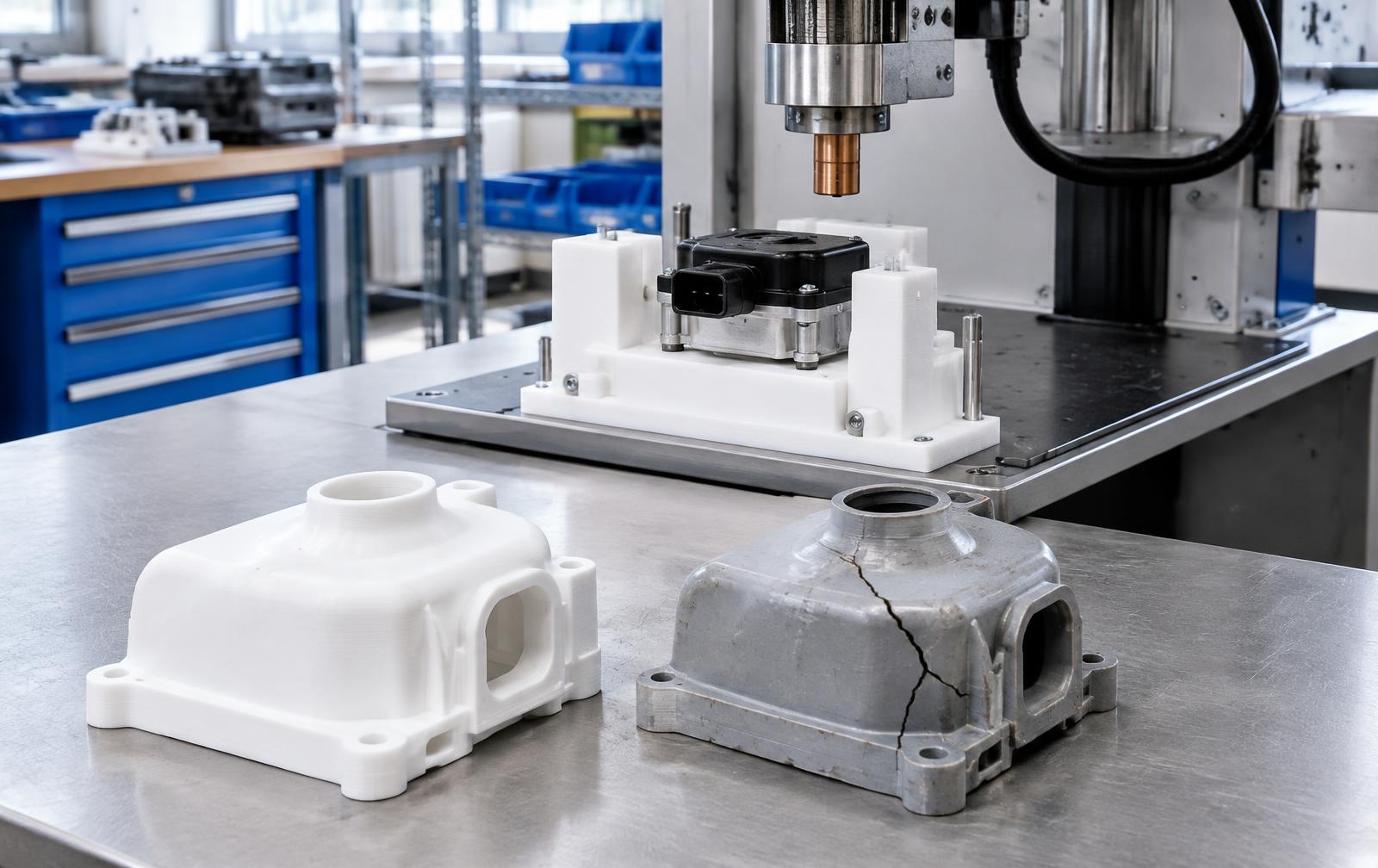
Manufacturing & Engineering:polycarbonate jigs and fixtures that sit beside curing ovens and heat-staking stations, go/no-go gauges that need to stay true, and assembly nests that get dropped on concrete.
Production Tooling:polycarbonate tooling for short runs, including forming tools, drill guides and alignment aids, printed in days rather than machined in weeks.
Robotics & Electronics:polycarbonate enclosures, insulating standoffs and mounts for parts that sit beside motors, drives and power supplies, with flame-rated enclosures moved to ULTEM 9085.
Automotive & Motorsport:polycarbonate automotive parts under the bonnet, clear of the exhaust and out of oil and fuel splash: brackets, ducting, sensor mounts and fitment templates.
Mining & Resources:polycarbonate replacement parts for plant and machinery whose original covers, housings and brackets are out of production, reproduced from a CAD file, a drawing or the broken original. Parts that live in the sun go to ASA.
Aerospace & Defence:test brackets, ducts and fit-check parts, with flame-rated work moved to ULTEM 9085.
Transport & Logistics:hot-running fittings, cable management and equipment housings in vehicles and depots.
Education & Research:test rigs, heated-chamber fixtures and experimental housings.
A common reason for polycarbonate prototype 3D printing: the part worked in ABS until it got warm. Not sure your part needs PC? Send it anyway. The file review is free.
Here's what drives polycarbonate 3D printing cost in Australia, and why a PC part usually costs more than the same part in ABS or ASA:
01
Material.Polycarbonate filament costs more per kilogram than ABS or ASA.
02
Machine time.PC prints on industrial FDM equipment with a heated chamber, which costs more per hour than standard FDM.
03
Preparation.Polycarbonate absorbs moisture from the air and must be dry before it prints well.
04
Height and volume.A tall part takes more layers than a flat one of the same weight.
05
Walls, infill and orientation.More walls add strength and time; orienting for load sometimes means more support material. We balance both and tell you if the trade-off matters.
06
Finishing.Parts ship as-printed by default. Machined features, inserts and sanding add labour.
07
Quantity.Several parts nested in one build cost less per part than one at a time.
If ABS or ASA would do the job, we'll tell you before you pay for PC. Send the file for a free, itemised quote on your actual part.
No account, no sales call and no minimum order. To order polycarbonate parts online:
01
Upload the file.STL, STEP or IGES, plus quantity and what the part has to survive: temperature, load, impact, chemicals, sun.
02
We check how the part will be used, not just the geometry.We review walls, bosses, orientation for load and heat margin, and confirm whether polycarbonate, ASA, Nylon 12 CF or ULTEM is the right call. If another material fits better, you'll hear it before anything prints.
03
Printed, inspected, dispatched.FDM parts ship within 24 hours of approval, and timing for larger builds is confirmed in your quote. We deliver to any address in Australia.
It's FDM printing with polycarbonate, a tough, heat-resistant engineering thermoplastic. Filament is melted and deposited layer by layer inside a heated build chamber. The finished parts hold their shape to about 138°C, take impact, insulate electrically and can be drilled and tapped, which makes PC a common choice for hot-running brackets, fixtures and enclosures.
Is 3D printed polycarbonate as strong as moulded polycarbonate?
No. Printed PC is strong for a printed plastic, but on standard notched impact tests moulded polycarbonate is roughly eight to eleven times tougher, and a printed part is weaker between its layers than along them. Heat resistance carries across almost fully. For safety guards or visors, use rated sheet or moulded polycarbonate.
How strong is a 3D printed polycarbonate part?
On the published datasheet for this class of FDM polycarbonate, tensile strength is about 57 MPa along the layers and about 36 MPa across them. We orient each part so its main load runs along the layers, and flag it if the geometry won't allow that.
What temperature can your polycarbonate parts handle?
Our polycarbonate is rated to about 138°C. That's where the plastic starts to give under a light load, so loaded parts or parts held at temperature for hours need a margin below it. Tell us the duty and we'll check the margin in the file review.
Can polycarbonate go in an engine bay?
Often, yes, as long as it's away from the exhaust, manifold and turbo and stays dry. Where oil or fuel splash is likely, Nylon 12 CF (about 147°C) is the better choice. Near the exhaust, or where temperatures approach PC's rating, we move to ULTEM 1010 (about 216°C) or metal.
Can you 3D print clear polycarbonate?
No. Our polycarbonate prints in opaque white, and layered FDM can't produce a glass-clear part in any material. For see-through parts we use Transparent Resin (SLA), Vero Clear (PolyJet) or transparent acrylic, each with a lower heat rating than PC.
Is polycarbonate resin the same as polycarbonate?
No. Resins sold as "polycarbonate-like" are photopolymers formulated to imitate some PC properties. Our polycarbonate is true PC thermoplastic printed on FDM equipment. If a drawing just says "PC", tell us how the part will be used and we'll confirm the right material.
Can polycarbonate parts be used outdoors?
Not for long-term sun exposure. Standard polycarbonate yellows and weakens in UV over time. ASA is the material we recommend for outdoor and sun-exposed parts. If heat is a bigger risk than sun, tell us the conditions and we'll talk it through.
Is polycarbonate flame retardant?
Our grade isn't. If a part needs a flame-retardant material, ULTEM 9085 is the option in our range.
What chemicals damage polycarbonate?
Acetone and other ketones, petrol and other aromatic solvents, ammonia and strong alkaline cleaners can craze or crack polycarbonate. Isopropyl alcohol is generally safe for cleaning. If the part will meet fuels, oils or solvents, Nylon 12 is usually the better choice.
Is polycarbonate a good electrical insulator?
Yes. Polycarbonate is a good electrical insulator, which is why it suits enclosures, standoffs and mounts around motors, drives and power supplies. It isn't a flame-retardant grade, so enclosures that must meet a flame rating go to ULTEM 9085.
What's the difference between polycarbonate and ABS?
ABS is rated to about 70°C and comes in 12 colours, which covers most indoor functional parts. Polycarbonate is rated to about 138°C, is stronger and stiffer, and prints in white. Move to PC when the part runs hotter than ABS can take, carries real load or keeps creeping out of shape in ABS.
What's the difference between polycarbonate and nylon?
Polycarbonate is stiffer and holds its shape at higher temperatures than unfilled nylon. Nylon has better chemical resistance, wear resistance and tolerance of repeated flexing. Nylon 12 CF adds stiffness and a heat rating of about 147°C, which makes it the better choice for hot parts that also see oil or fuel.
What's the difference between polycarbonate and ASA?
ASA is UV-stable and rated to about 98°C, so it's the choice for parts in the sun. Polycarbonate is rated to about 138°C and is stronger and stiffer, but isn't rated for long-term UV exposure. Outdoors in full sun, ASA. Hot or heavily loaded, polycarbonate.
When should I choose ULTEM over polycarbonate?
Choose ULTEM when the part needs a flame-retardant rating (ULTEM 9085) or has to work above polycarbonate's range (ULTEM 9085 at about 153°C, ULTEM 1010 at about 216°C). Otherwise, polycarbonate does the job at a lower cost.
Do you offer PC-ABS or carbon fibre polycarbonate?
Neither is in our published range. For a tough, easier-to-finish production plastic, ABS-M30i is the closest option; for a stiff, heat-tolerant composite, Nylon 12 CF.
Is polycarbonate food safe?
We don't supply polycarbonate parts for food or drink contact. Printed layers can trap residue. If your part needs food contact, tell us the application and we'll advise on the options in our range.
How accurate are your polycarbonate prints?
Tolerance is ±0.15mm per 100mm, with finest detail of 1.0mm and a minimum wall of 1.0mm. Allow a small clearance on mating parts and we'll flag any fits that look too tight.
What's the largest polycarbonate part you can print?
Up to 914 × 609 × 914mm in one piece.
What colours does polycarbonate come in?
White. If you need a colour, parts can be painted after printing. Tell us the finish and we'll confirm the options in your quote.
Can polycarbonate parts be drilled, tapped or fitted with inserts?
Yes. PC drills, taps and accepts threaded inserts well. Tell us which features need machining and we'll size the walls and bosses to suit.
How much does polycarbonate 3D printing cost?
It depends on material, machine time (mostly height and volume), walls and infill, orientation and supports, finishing and quantity. PC usually costs more than ABS or ASA. Upload your file for a free, itemised quote on your exact part.
How fast can I get polycarbonate parts?
FDM parts ship within 24 hours of order approval. Larger builds are confirmed in your quote. Delivery time then depends on your location and shipping option.
Is there a polycarbonate 3D printing service near me?
You don't need a printer in your postcode. Quantix 3D Printing runs one national service, so instead of searching for polycarbonate 3D printing near me, upload your file from any state or territory and the finished parts come to your door.
Is there a minimum order?
No minimum quantity and no minimum order value. One replacement bracket is quoted the same way as a run of fifty fixtures.
Are my files kept confidential?
Yes. Every file and project detail stays private.
Do you sell polycarbonate filament or sheet?
No. We print finished parts from your files. For filament, try an Australian filament retailer. For sheet or cut-to-size panels, a plastics fabricator is the right place to look.
Send Us the Part That Runs Hot
Rated to about 138°C. ±0.15mm per 100mm. Up to 914mm in one piece. Checked by an engineer before it prints. Quantix 3D Printing is the polycarbonate 3D printing company Australia's maintenance, tooling and product teams turn to when ABS has given up and the part still has to work. Whether it's one bracket or a run of fixtures, upload the file for a free quote and a straight answer on whether polycarbonate is the right plastic for it. No minimum order, no lock-in, and delivery to any state or territory.