
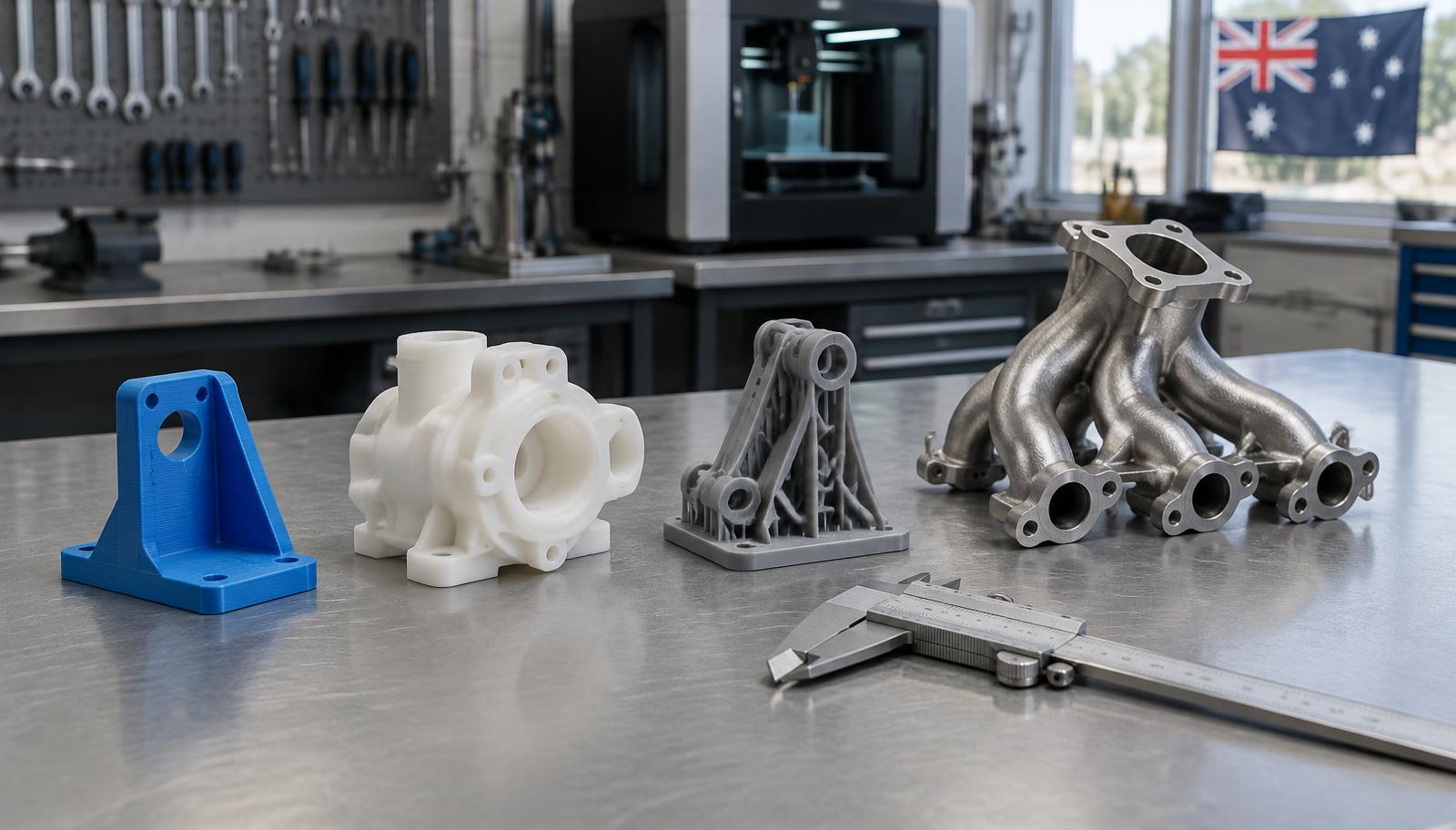
The Short Answer
3D printing cost Australia: seven variables set the price, namely process, material, part volume, geometry, quantity, post-processing and turnaround. In published Australian price guides, a one-off FDM plastic part typically runs about $30 to $150, nylon SLS or MJF parts about $300 to $1,800, and metal parts from about $500 to $10,000 or more. A small FDM bracket and a large, finished metal component can sit orders of magnitude apart in price, even when both are called "3D printing".
For most plastic parts, price is driven mainly by machine time and finishing labour rather than by the raw material itself. For metal parts, machine time and material both weigh heavily, and build preparation and post-processing add further cost. In both cases, price per part usually falls as more parts share a single build.
If you need a number for a specific part, the reliable route is to send the file, material preference and quantity to a supplier and request a quote. The sections below show what that quote is actually made of.
3D Printing Price in Australia: Typical AUD Ranges
The figures below combine indicative per-part ranges published by Australian providers with rates published by universities and councils. They are guides, not quotes, and sources differ on whether GST is included, so confirm that when you compare.
Typical price per part by process
The ranges below are indicative for small to medium parts, roughly 100 × 100 × 50mm. Larger and more complex parts sit higher.
| Process | One-off part (AUD) | Batch of 10 to 50 (per part) |
|---|---|---|
| FDM | $30 to $150 | $15 to $80 |
| SLA (resin) | $100 to $800 | $60 to $250 |
| SLS (nylon) | $300 to $1,500 | $150 to $600 |
| MJF (nylon) | $400 to $1,800 | $150 to $700 |
| PolyJet | $500 to $2,000 | $300 to $1,200 |
| Metal (SLM and DMLS) | $500 to $10,000+ | Quote only |
Small aluminium or stainless steel parts typically fall at the lower end of the metal range, from about $500 to $2,000, while large or complex titanium and nickel alloy parts can exceed $10,000.
What quantity does to the price
- Nylon SLS: a single part at about $400 to $600 can fall to about $150 to $200 per part in a batch of 50.
- FDM bracket: a single bracket at about $180 can fall to about $80 each at 40 units.
- Project minimums: providers commonly set minimum project fees of around $180, with $180 to $220 cited for professional providers in Canberra.
- Hourly rates: professional services often charge $30 to $150 per hour depending on printer type, resolution and supervision.
Rates published by universities and councils
Public institutions publish rates that show how machine time and operator time are charged. Most of these are access rates for makerspaces and research facilities, so they sit below commercial per-part pricing, but they are a verifiable reference point.
| Institution | Published rate (AUD) | Source |
|---|---|---|
| University of Melbourne, MSD Makerspace (commercial jobs) | $85 to $120 per hour for file setup and machine operation, with materials charged separately | unimelb.edu.au |
| University of Sydney, Sydney Manufacturing Hub (external academic and not-for-profit users, 2026, excluding GST) | $30 booking rate for polymer printers and $90 for metal printers; consumables at cost; staff assistance $150 per hour (academic) or $300 per hour (commercial) | sydney.edu.au |
| UNSW Making Centre, Makerspace | FDM at $3.00 per hour, capped at $30.00 per build plate; Formlabs Form 4 resin at $0.60 per mL | making.unsw.edu.au |
| UTS ProtoSpace | No fixed 3D printing rates; printing is subject to formal quotation, with cost depending on design complexity, build time, tolerances, post-processing and material (rates excluding GST) | uts.edu.au |
| City of Armadale Library (WA) | $10 for the first hour, then $3 per additional hour, PLA on a FlashForge Guider 3 (up to 290 × 240 × 330mm) | library.armadale.wa.gov.au |
| Lane Cove Council Library (NSW) | $5.50 per job plus $0.10 per minute of print time (about $6 per hour) | lanecove.nsw.gov.au |
For a retail benchmark, a basic PLA print service for models under 200g has been listed at $19.95 including GST, and $59.95 including GST for models under 1,000g.
How to use these figures
Treat the process table as a budgeting range and the institution rates as a reference for how machine and operator time are charged. Metal and large industrial parts are generally priced by quote, including at universities such as UTS. The next sections explain why a part lands at the low or high end of each range.
What Determines 3D Printing Service Cost
1. The printing process
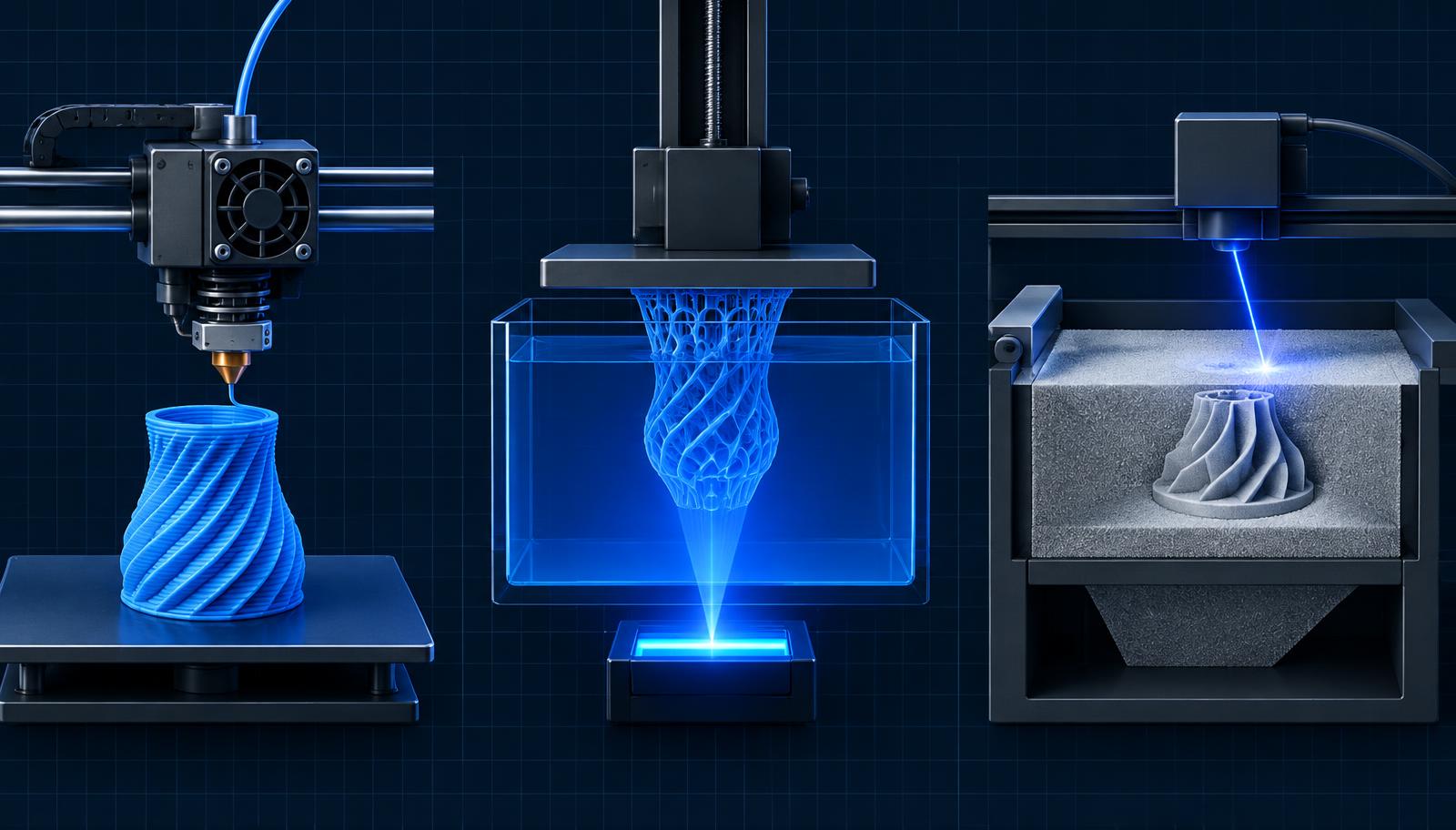
Each process has its own machine cost, speed, material cost and finishing requirements. Quantix 3D Printing operates seven processes: FDM, SLA, SLS, MJF, PolyJet, SLM and DMLS. In broad terms:
- FDM extrudes thermoplastic filament and suits functional prototypes, jigs, fixtures and larger parts.
- SLA cures liquid resin with a laser and suits fine detail and smooth surfaces.
- SLS and MJF fuse nylon powder and suit durable, complex parts and batch production.
- PolyJet jets photopolymer droplets and suits multi-material and high-detail models.
- SLM and DMLS melt metal powder and suit complex metal components.
Choosing the process that matches the function of the part, rather than the most advanced option available, is the single largest lever on price. For a side-by-side look at the three most common plastic options, see our guide to FDM vs SLA vs SLS.
2. Material
Material cost per kilogram varies enormously between families. Standard thermoplastics sit at the lower end, engineering polymers such as nylons and reinforced grades sit in the middle, and metals and high-performance alloys sit at the top. Composite and high-temperature materials can cost many times more than standard plastics.
Material also affects price indirectly. Some materials take longer to finish, some need controlled print conditions, and some powders can only be partly recycled between builds. Quantix 3D Printing offers 45+ engineering materials across plastic and metal families, so it is usually possible to find a grade that meets the mechanical requirement without over-specifying.
3. Part size and volume
Larger parts consume more material and occupy a machine for longer. Two measurements matter: the volume of the part itself and the space it takes up inside the build chamber, often called the bounding box. A tall, thin part can cost more than its material volume suggests because it limits how many other parts can be built alongside it.
Price does not rise in perfect proportion to size. Setup time is spread across the whole part, so doubling the volume typically costs a little less than double.
4. Geometry, orientation and supports
Added complexity often costs little in additive manufacturing, but it is not always free. Overhangs in FDM and SLA need support structures that use extra material, add print time and must be removed by hand. Thin walls, deep internal channels and trapped powder or resin add inspection and cleaning time. Print orientation changes build height, surface finish and support volume, all of which feed into price.
Quantix 3D Printing builds parts up to 1700 × 800 × 800mm, with a minimum feature size down to 10 × 10mm, so very large and very small parts are both within range. The geometry still shapes the quote.
5. Quantity
Setup, file preparation and machine loading are largely fixed per job. Spread across ten parts instead of one, they shrink to a fraction of the unit price. In powder processes such as SLS and MJF, many parts nest in the same build volume, which spreads machine time as well.
The same effect is strong in metal builds. Industry cost studies of laser melting report that building multiple parts together can reduce cost per part substantially compared with single-part builds. If you expect to need more than one part, ask for pricing at several quantities.
6. Post-processing and finishing
Raw printed parts are rarely the finished product. Support removal, depowdering, sanding, bead blasting, dyeing, vapour smoothing, painting, threaded inserts and heat treatment each add labour, time or equipment cost. Industry cost guides regularly note that raw material is a minority share of the final price once labour, machine wear and finishing are counted.
Ask whether a quote is for a part straight from the machine or one that is finished to a stated surface standard. Comparing two quotes without checking this is one of the most common causes of apparent price gaps.
7. Turnaround time
Speed can affect price. A job that fits into the normal production queue is easier to schedule than one that requires the queue to be rearranged. Quantix 3D Printing dispatches FDM parts within 24 hours, and other processes typically turn around in 5 to 6 working days. If your schedule has flexibility, mention it when you request a quote.
How the Seven Processes Compare on Price
The table below shows typical relative positions, not fixed prices. Actual figures depend on part size, material, quantity and finishing.
| Process | Typical strength | Relative price per part | Where price moves most |
|---|---|---|---|
| FDM | Functional prototypes, jigs, large parts | Lower | Print time, supports, layer height |
| SLA | Fine detail, smooth surfaces | Lower to moderate | Resin type, support removal, finishing |
| SLS | Durable nylon parts, complex shapes | Moderate | Build nesting, powder, depowdering |
| MJF | Consistent nylon parts, batch runs | Moderate | Batch size, dyeing and finishing |
| PolyJet | High detail, multi-material models | Moderate to higher | Material choice, support cleaning |
| SLM | Complex metal parts, dense structures | Higher | Machine time, powder, support removal |
| DMLS | Metal functional parts, alloys | Higher | Machine time, heat treatment, machining |
Two practical rules follow from the table. First, for one-off plastic parts, FDM is usually the lower-priced process, so it is the natural starting point for fit checks and fixtures. Second, for repeatable batches of 50 or more nylon parts, SLS and MJF tend to become more efficient per part because of nesting.
Material Price Tiers
Material prices shift with supply, so it helps to think in tiers:
- Standard plastics: PLA, PETG, ABS and ASA, used for prototypes, enclosures and fixtures. Raw filament is commonly quoted at about $20 to $60 per kg.
- Engineering plastics: nylons, polycarbonate blends and reinforced grades, used where strength, heat or chemical resistance matters. Raw material is commonly quoted at about $70 to $150 per kg.
- Photopolymer resins: standard, tough, flexible and high-temperature grades, priced by performance.
- Metals: stainless steel and aluminium alloys sit below titanium and nickel-based superalloys, which sit at the top of the price range.
Specifying a stronger material than the part needs is a quiet source of overspend. A short conversation about operating load, temperature and environment usually narrows the list quickly.
Costs That Are Easy to Overlook
A fair comparison between suppliers looks past the headline price. Check each of these:
- Setup and file preparation: some suppliers fold these into the unit price, others itemise them.
- Support and finishing: confirm what condition the part is delivered in.
- Failed builds: a part that fails mid-build costs machine time, so ask how failed builds and reprints are handled.
- Freight: delivery across a country this size varies with part dimensions and location.
How to Manage the Price of a 3D Printed Part
You can influence price significantly before a file is submitted. These design and specification choices have the most effect:
- Hollow or lattice the interior where full density is not required. This reduces material and print time.
- Orient and design to minimise supports. Chamfers in place of sharp overhangs often remove support needs.
- Merge assemblies into single parts. One consolidated part can replace several printed or machined components and the fasteners that join them.
- Relax tolerances and finishes where they are not functional. Specify tight tolerances only on mating surfaces.
- Consolidate orders. Printing multiple parts together improves nesting and spreads setup time.
- Match material to load, not to habit. Standard plastics are often adequate for fit and form checks, with engineering grades reserved for final validation.
- Allow standard lead time when the schedule permits.
3D Printing Versus CNC Machining and Injection Moulding
Additive manufacturing is not always the right process, and comparing it with traditional methods helps set a realistic budget.
- Prototypes and one-offs: 3D printing usually wins. There is no tooling, and iterations are quick.
- Low-volume production and replacement parts: 3D printing is often the most practical choice, especially for discontinued or hard-to-source components where tooling would never pay back.
- Complex internal geometry: metal 3D printing can produce channels, lattices and hollow forms that machining cannot reach.
- Simple, high-volume parts: injection moulding becomes more economical once tooling cost is spread over thousands of units. As CSIRO commentary notes, 3D printing costs remain higher for high-volume, simple components.
- Tight-tolerance solid metal parts: CNC machining is frequently the more economical route, and many metal printed parts are finished by machining critical surfaces.
What to Prepare for an Accurate Quote
A complete brief shortens the quoting cycle and reduces the chance of a revised price later.
Prepare:
- A 3D file in STL, STEP or similar format.
- The material or the performance requirement (strength, heat, flexibility, chemical exposure).
- The quantity, and any likely repeat orders.
- Surface finish and tolerance expectations.
- Delivery location and required date.
- Any confidentiality requirements.
At Quantix 3D Printing, files are handled in confidence, and parts are delivered Australia-wide from Chadstone, Victoria.
Why Work With Quantix 3D Printing
Quantix 3D Printing is an industrial additive manufacturing company with seven processes under one roof, so the recommendation can be based on what the part needs rather than on a single machine. The team covers manufacturing and parts replacement across industries, from jigs and fixtures to end-use components and low-volume runs.
Practical advantages when you are budgeting:
- Process choice: FDM, SLA, SLS, MJF, PolyJet, SLM and DMLS, matched to the job.
- Material range: 45+ engineering materials across plastic and metal families.
- Large build envelope: up to 1700 × 800 × 800mm.
- Clear lead times: 24-hour FDM dispatch and 5 to 6 working days for other processes.
- Confidential handling: your designs stay with you.
To get pricing on a part, send your file, material preference and quantity through the Quantix 3D Printing contact page and an engineer will review it.
Frequently Asked Questions
How much does 3D printing cost?
In Australia, a one-off FDM plastic part typically costs about $30 to $150, SLA resin parts about $100 to $800, nylon SLS and MJF parts about $300 to $1,800, and metal parts from about $500 to $10,000 or more. The exact price depends on process, material, size, geometry, quantity and finishing, so the only reliable figure for your part comes from a quote based on your file.
Why is metal 3D printing more expensive than plastic?
Metal systems have high capital and operating costs, metal powders cost far more per kilogram than polymers, and parts need support removal, stress relief and often machining. These costs are why metal is best reserved for parts where its strength, heat resistance or design freedom is required.
Does quantity reduce the price per part?
Yes. Setup and file preparation are largely fixed per job, and powder and metal processes nest multiple parts in a build. Published Australian examples show a single SLS nylon part at about $400 to $600 falling to about $150 to $200 per part in a batch of 50. Requesting pricing at several quantities shows where the break points fall.
Is it better to buy a 3D printer or use a service?
Industrial-grade systems require significant capital, trained operators, material handling, maintenance and post-processing equipment. For occasional or varied work, a service provider is usually more practical. Owning equipment tends to make sense only for sustained, repeatable demand in a single process.
How long does a 3D printing order take?
Turnaround depends on process, part size and finishing. At Quantix 3D Printing, FDM parts are dispatched within 24 hours and other processes typically take 5 to 6 working days, with delivery Australia-wide.
What file do I need to get a quote?
A 3D model in STL or STEP format is the standard starting point. Adding material, quantity, tolerance and finish requirements helps the quote be accurate the first time.
What It Comes Down To
A 3D printing price is the sum of machine time, material, labour and finishing, shared across the parts in a build. The levers you control are process, material, design, quantity and schedule, and a quote based on your file turns the ranges above into a figure for your part.
Ready to price a part? Send your file to Quantix 3D Printing and get a clear quote with the process and material matched to your application.