
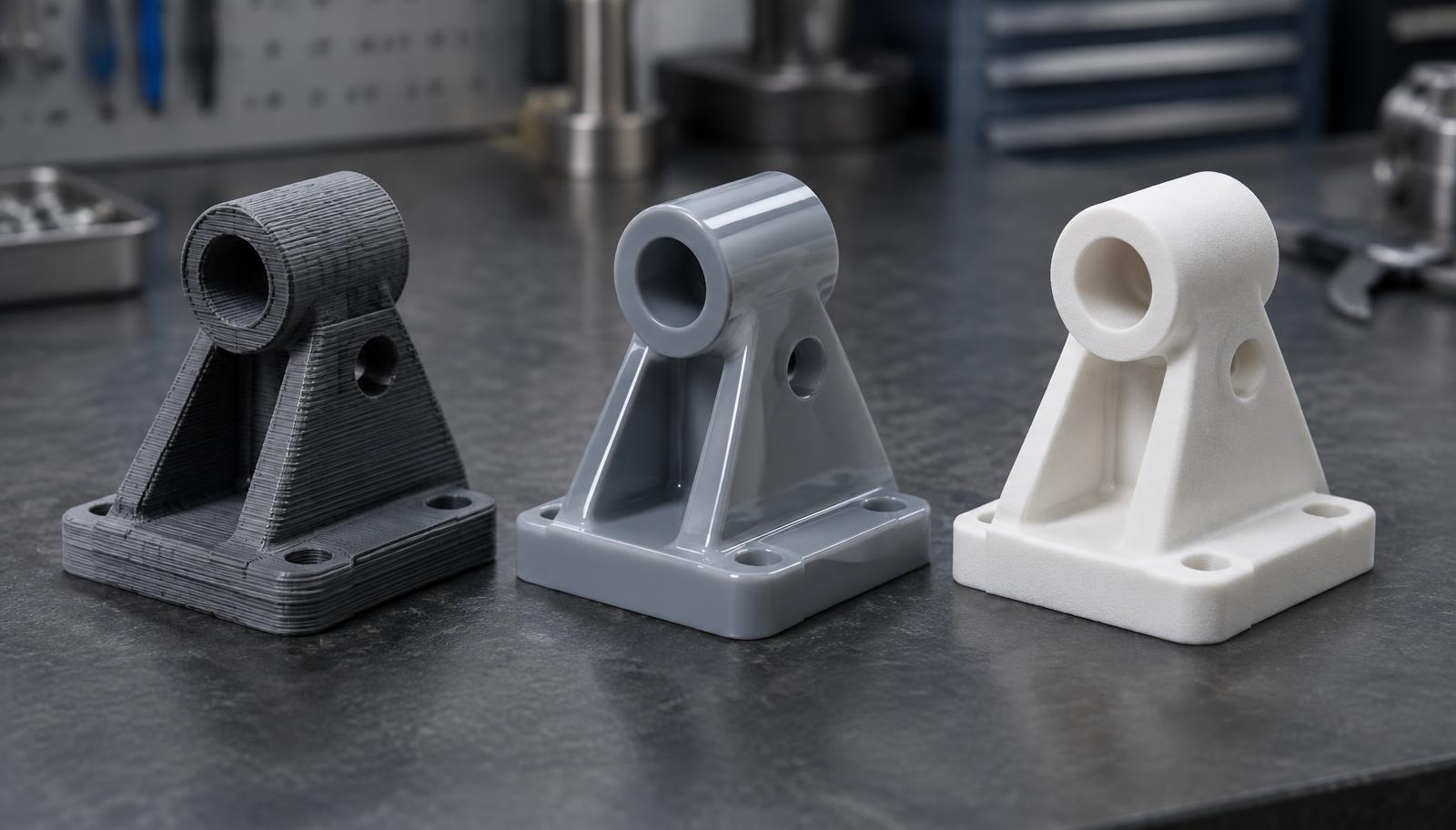
Key takeaways
- FDM: 24-hour dispatch, 11 engineering thermoplastics, tolerance of ±0.15mm per 100mm, single parts up to 914 × 609 × 914mm.
- SLA: the smoothest as-built finish, detail down to 0.2mm, tolerance of ±0.1mm per 100mm, single parts up to 1700 × 800 × 800mm.
- SLS: tough nylon parts with no support structures, detail down to 0.3mm, tolerance of ±0.1mm per 100mm, single parts up to 675 × 545 × 366mm.
- Rule of thumb: choose FDM for speed and large functional parts, SLA for finish and detail, and SLS for complex functional geometry.
Extrusion, Resin or Powder: How FDM, SLA and SLS Work
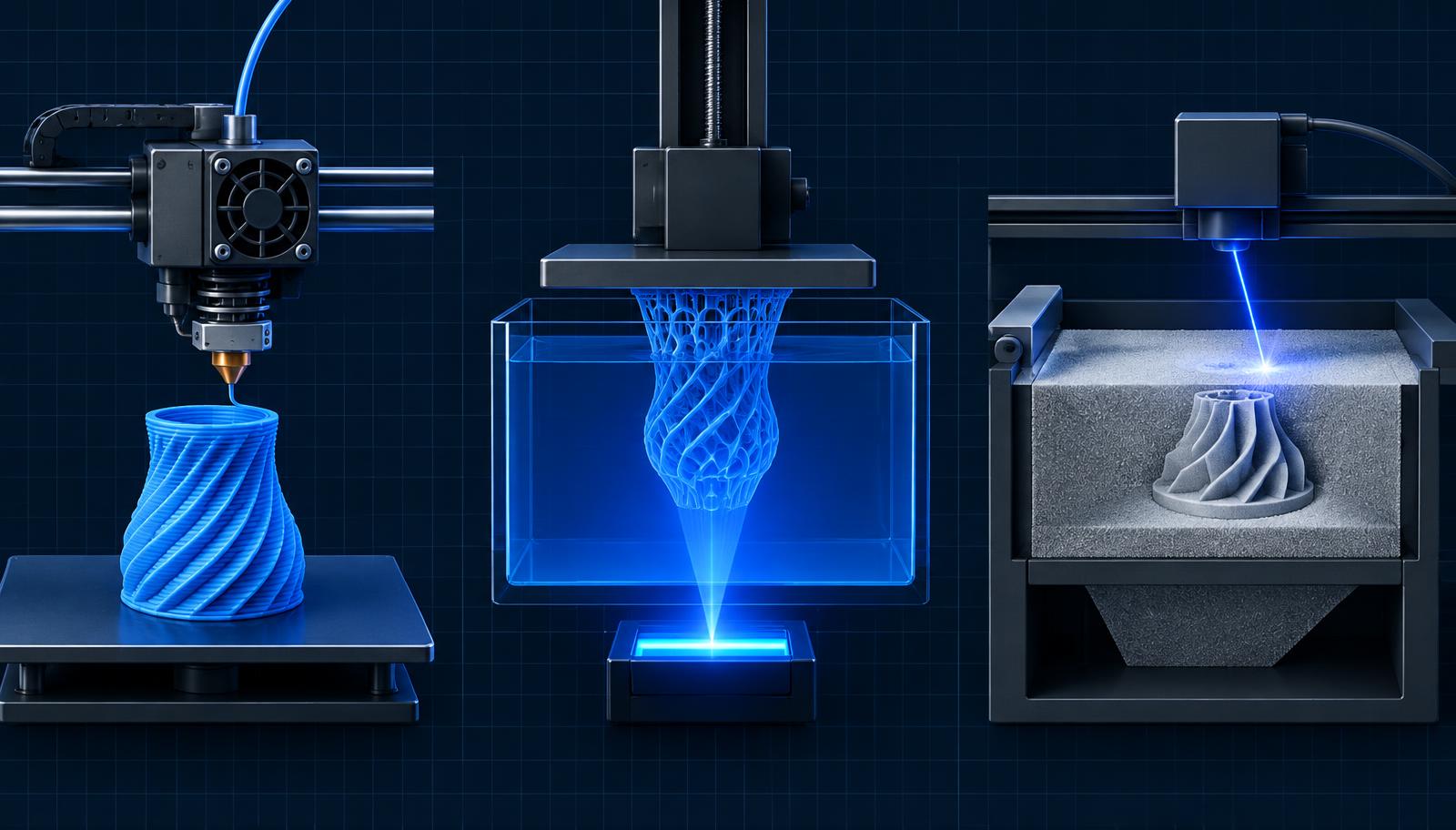
Each of the three processes belongs to a different family of additive manufacturing, as defined by ISO/ASTM 52900, the international terminology standard for the industry. FDM is a material extrusion process, SLA is a vat photopolymerisation process, and SLS is a powder bed fusion process. Those families explain almost every trade-off covered in this guide.
What is FDM 3D printing?
FDM (Fused Deposition Modelling) is a material extrusion process that feeds solid thermoplastic filament through a heated nozzle and draws each layer of a part onto a build plate. Overhangs need temporary support material, which is removed after printing.
Because FDM prints genuine engineering thermoplastics, its material range is broad. Quantix runs 11 FDM materials. They range from PLA for concept models and ASA for outdoor parts to polycarbonate and carbon-fibre-filled Nylon 12 for structural work, with ULTEM 1010 at the top end, rated to roughly 216°C.
Read more about FDM 3D printingWhat is SLA 3D printing?
SLA (Stereolithography) is a vat photopolymerisation process that uses a UV laser to cure liquid photopolymer resin, one layer at a time. Like FDM, it needs printed supports for overhanging geometry. After printing, parts are washed, de-supported and UV post-cured to reach final strength.
Read more about SLA 3D printingWhat is SLS 3D printing?
SLS (Selective Laser Sintering) is a powder bed fusion process. A laser fuses the part's cross-section into a thin layer of nylon-based powder inside a heated build chamber, and the unfused powder around the part supports it throughout the build. As a result, SLS needs no support structures.
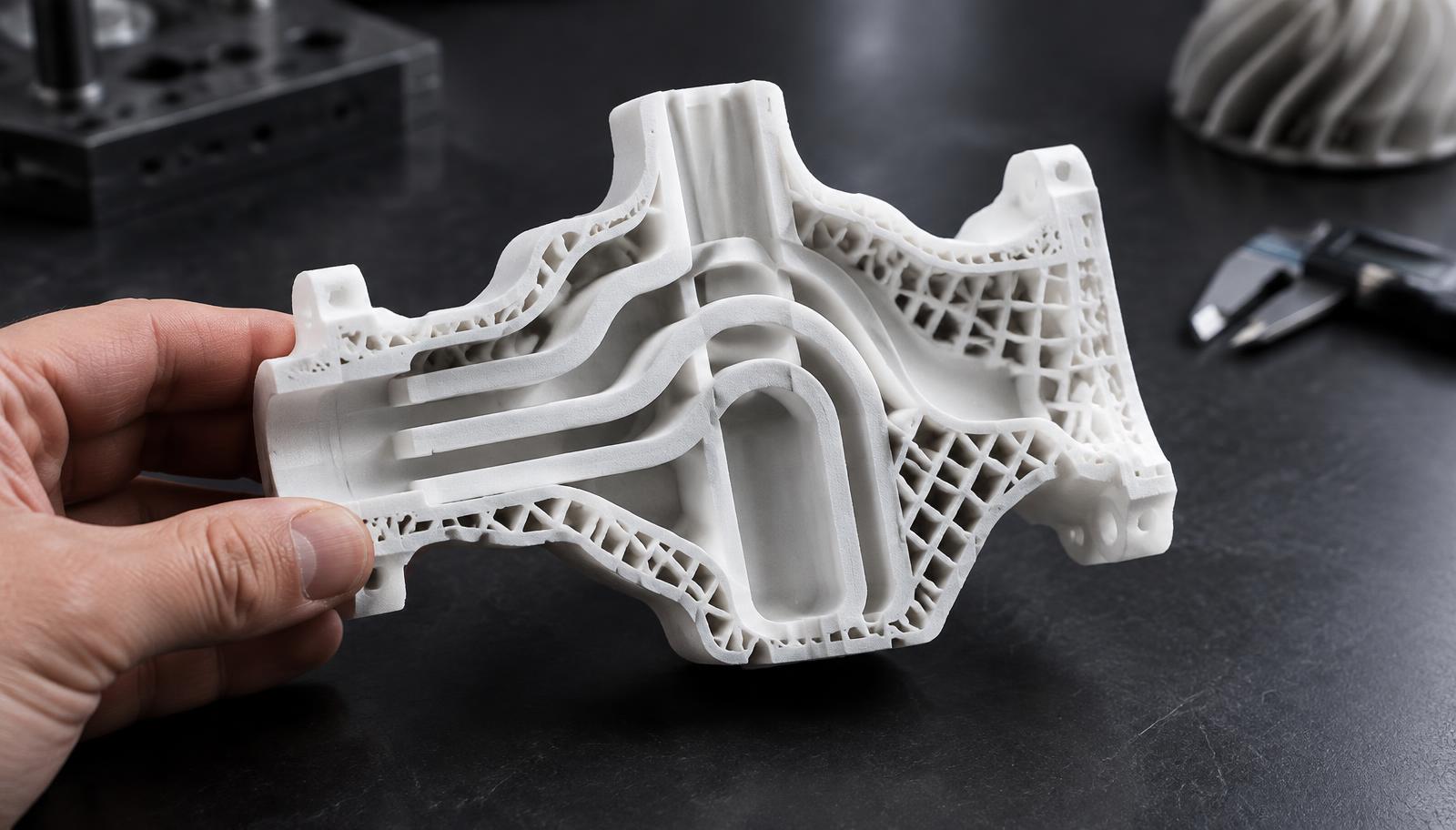
That single fact changes what you can design: internal channels, interlocking assemblies, thin walls and organic shapes all print cleanly, and many parts can be nested together in one build.
Read more about SLS 3D printingThree 3D Printing Processes Compared, Side by Side
Here's how the three stack up on the specifications that matter to an engineering brief. Every figure is Quantix 3D Printing's own published capability, not an industry average.
| Specification | FDM | SLA | SLS |
|---|---|---|---|
| Process family | Material extrusion | Vat photopolymerisation | Powder bed fusion |
| How it builds | Melted thermoplastic filament, extruded layer by layer | UV laser cures liquid resin in a vat | Laser fuses nylon-based powder in a heated bed |
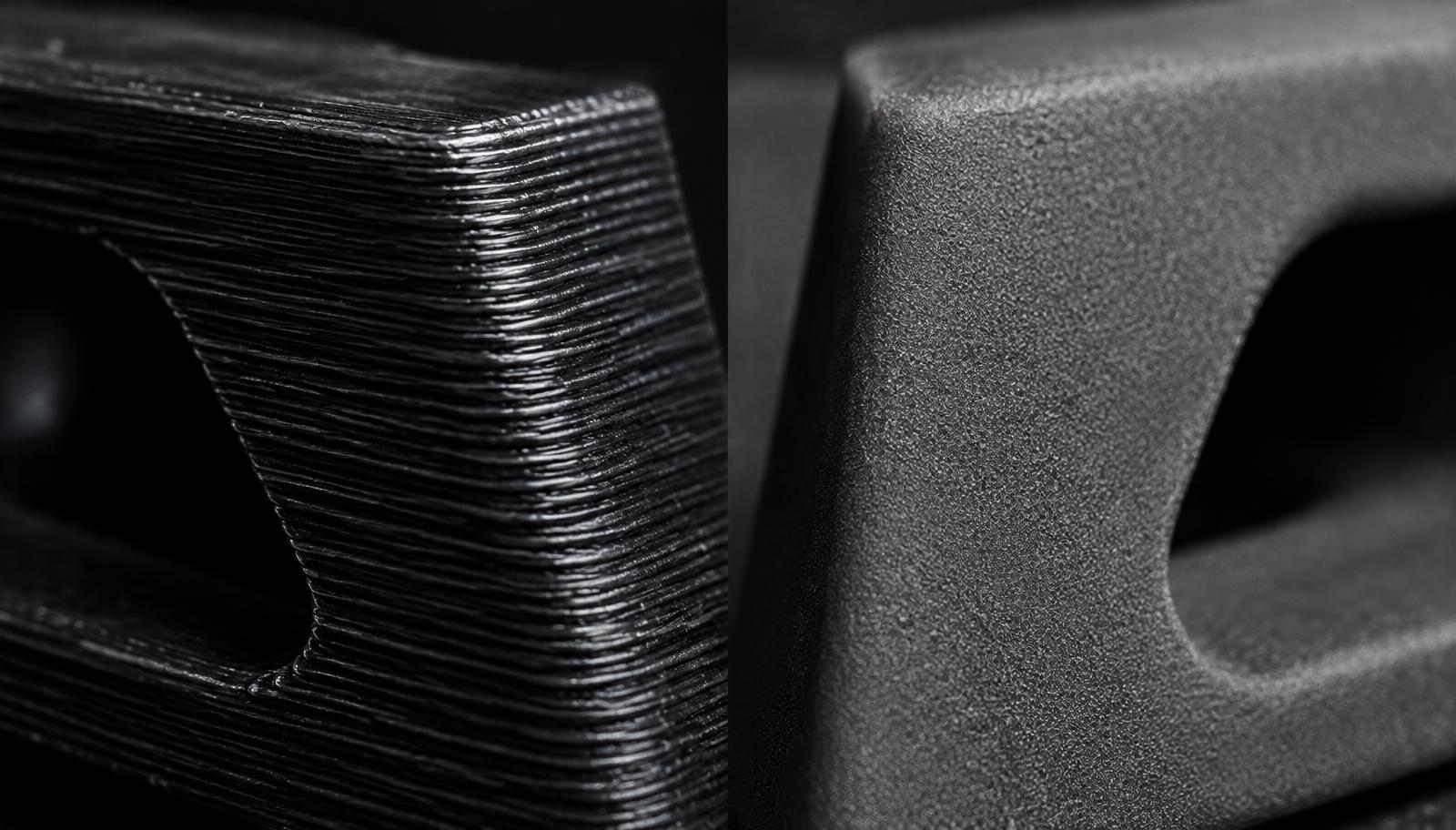
| As-built surface finish | Lightly textured, visible layer lines | Ultra-smooth, near-moulded | Matte, slightly grainy |
| Finest detail | 1.0mm | 0.2mm | 0.3mm (Nylon PA2200) |
| Minimum wall thickness | 1.0mm | Confirmed at file review | 0.7mm (Nylon PA2200) |
| Tolerance | ±0.15mm per 100mm | ±0.1mm per 100mm | ±0.1mm per 100mm |
| Largest single piece | 914 × 609 × 914mm | 1700 × 800 × 800mm | 675 × 545 × 366mm |
| Support structures | Needed for overhangs | Needed for overhangs | None needed |
| Strength profile | Strong along layers, weaker between them | Rigid and accurate; standard resins less impact-tolerant than nylon | Tough nylon, more uniform in every direction |
| Heat resistance (range offered) | ~70°C (PLA, ABS) to ~216°C (ULTEM 1010) | High-temperature resin available | ~150°C to 180°C across the four powders |
| Materials at Quantix | 11 thermoplastics | 4 resins: rigid, clear, flexible, high-temperature | 4 powders: PA2200 nylon, glass-filled nylon, Alumide, flexible PEBA |
| Typical dispatch | Within 24 hours | 5 to 6 working days | 5 to 6 working days |
How we compiled this table: figures come from Quantix 3D Printing's published process and material specifications. Tolerance is stated per 100mm of part length; achievable accuracy on your part depends on geometry, orientation and material, and is confirmed at quote stage.
Is SLA Stronger Than FDM? Is SLS Stronger Than Both?
For most functional parts, SLS nylon is the strongest all-rounder of the three, because its strength is consistent in every direction. Engineering-grade FDM can rival it when the load runs along the printed layers, while SLA is generally the least suited to impact and repeated flexing.
The difference comes down to how each process bonds its layers:
- FDM parts are strongest along the printed layers and weakest across them, because each layer bonds to the one below as it cools. That's why we orient a bracket so its main load runs along the layers. Printed this way, polycarbonate, Nylon 12 CF and the ULTEM grades produce genuinely structural parts.
- SLA parts are rigid and dimensionally accurate, but standard resins are better suited to form, fit and appearance than to repeated impact or snap fits.
- SLS fuses powder into a more uniform solid, so nylon parts behave consistently whichever way the load runs. That's why SLS suits clips, hinges and housings that take stress from several directions.
Which 3D Printing Process Is Most Accurate?
SLA and SLS are the most accurate of the three, both holding ±0.1mm per 100mm at Quantix, compared with ±0.15mm per 100mm for FDM. SLA also captures the finest features, down to 0.2mm, versus 0.3mm for SLS and 1.0mm for FDM.
Accuracy isn't only about tolerance, though. SLA support removal can leave small witness marks, and FDM layer lines affect how mating surfaces seat. For tight-fitting assemblies, allow a small clearance and tell us which faces are critical so we can orient the part to protect them.
Five Questions That Decide the Process
1. Does the part carry load?
If the part has to hold a fastener, take a knock or flex with every cycle, start with SLS nylon or an engineering-grade FDM material. Reserve SLA for parts where appearance and fit matter more than impact.
2. Will anyone look closely at it?
For a client-facing prototype, styling model or master pattern for moulding, SLA is hard to beat: its surface needs far less sanding to reach a paint-ready finish. SLS gives a uniform matte finish that suits functional parts. FDM shows layer lines, which is fine on a shop-floor jig but less so in a client presentation.
3. How big is it?
Size often decides for you. SLA reaches 1700 × 800 × 800mm in a single piece, which avoids bonded seams on large covers and machine-guard mockups. FDM handles up to 914 × 609 × 914mm in engineering materials, and larger parts can be split and bonded. SLS tops out at 675 × 545 × 366mm, so it suits small to medium parts, especially in batches.
4. How complex is the geometry?
Count overhangs, internal cavities and enclosed channels. On FDM and SLA, every overhang needs a support, and internal passages can be difficult to clear. SLS avoids both problems, so designs with cooling channels, captive hinges or print-in-place assemblies usually point straight to it.
5. How soon, and how many?
FDM is the fast lane: standard FDM jobs at Quantix dispatch within 24 hours, which suits rapid design iteration. SLA and SLS typically take 5 to 6 working days. Quantity matters too: on small production runs, SLS nesting spreads the cost of each build across many parts.
What Drives Cost for Each Process?
There's no flat rate across FDM, SLA and SLS, because each process has its own cost drivers:
FDM
print time and material grade. PLA and ABS sit at the lower end of the range, while polycarbonate, carbon-filled nylon and ULTEM cost more because the materials themselves do. For one-off parts, FDM usually keeps costs down.
SLA
resin, laser time and support removal. Every support is removed by hand, so labour scales with geometric complexity, not just size.
SLS
powder, machine time and nesting. The more parts that share a build, the more widely its cost is spread.
The most reliable way to compare is to quote the same file across processes. A provider that runs all three can tell you which one suits the part, rather than which machine happens to be free.
Matching Processes to Common Engineering Parts
Here's how our team typically approaches parts from engineering and manufacturing teams across Australia:
| Part | Recommended process and material | Why |
|---|---|---|
| Assembly-line jig or fixture | FDM, Nylon 12 CF or polycarbonate | Stiff, fast to iterate, quick to reprint when the line changes |
| Mounting bracket near a heat source | FDM in polycarbonate or ULTEM, or SLS glass-filled nylon | Sustained heat resistance; SLS if the geometry is complex |
| Electronics enclosure with snap fits | SLS, Nylon PA2200 | Clips flex repeatedly without cracking; internal bosses need no supports |
| Presentation prototype or styling model | SLA, rigid resin | Smooth, paint-ready surface and crisp detail |
| Large fit-check mockup of a cover or guard | SLA, single piece up to 1700mm | No bonded seams |
| Gasket, seal or soft-touch grip | SLS flexible PEBA or SLA flexible resin | PEBA for durability, resin for finish |
| Outdoor housing or bracket | FDM, ASA | Resists the UV yellowing that standard ABS suffers in strong Australian sun |
| Flow-visualisation part | SLA, transparent resin | Shows what's happening inside |
Design Mistakes We Flag at File Review
Our team checks every file before it prints. These are the process-specific issues we look for most often, and they're worth checking in your own CAD model before you send it:
- FDM, load across the layers: a bracket loaded perpendicular to its layers can split along a layer line. We'll suggest a print orientation that keeps the load running along the layers.
- FDM, walls under 1.0mm: walls thinner than the 1.0mm minimum won't print reliably. Thicken them or consider SLS.
- SLA, supports on cosmetic faces: supports leave small marks where they're removed. Tell us which faces are visible and we'll plan support placement around them.
- SLA, undrained hollow sections: enclosed hollows can trap liquid resin. Add a drain hole or print the section solid.
- SLS, trapped powder: hollow parts need escape holes so unfused powder can be cleared after the build.
- All processes, zero-clearance fits: mating parts printed with no clearance often won't assemble. Allow a small gap; we'll also flag any fits that look too tight.
When None of the Three Is the Right Answer
FDM, SLA and SLS cover most plastic parts, but not every one. For production-volume nylon parts with tight part-to-part consistency, MJF (Multi Jet Fusion) is often the better fit. For multi-material or full-colour models, PolyJet does what none of the three can. When plastic can't handle the heat, load or corrosion a part will face, metal 3D printing is the next step.
To compare all five plastic processes in one place, see our plastic 3D printing service. For heat ratings, colours and build sizes by material, see the 3D printing materials guide.
Frequently Asked Questions
What is the difference between FDM, SLA and SLS?
FDM extrudes melted thermoplastic filament layer by layer, SLA cures liquid resin with a UV laser, and SLS fuses nylon powder with a laser. FDM is the fastest and suits functional parts, SLA gives the smoothest finish and finest detail, and SLS produces tough parts with complex geometry and no support structures.
Is SLA stronger than FDM?
Generally not for functional use. Engineering FDM materials such as polycarbonate, carbon-filled nylon and ULTEM handle load and impact better than standard SLA resins, provided the part is oriented so load runs along the layers. SLA is the better choice when finish and detail matter more than strength.
Is SLS better than FDM?
For complex functional parts, often yes: SLS needs no supports, and its nylon parts are consistently strong in every direction. FDM is better when you need a part within 24 hours, a larger single piece, or materials such as ASA, polycarbonate or ULTEM.
Which 3D printing process is most accurate?
SLA and SLS both hold ±0.1mm per 100mm at Quantix, compared with ±0.15mm per 100mm for FDM. SLA captures the finest detail, down to 0.2mm.
Does SLA 3D printing need supports?
Yes, for overhanging geometry. Supports are removed by hand after printing, and we place them away from visible faces where possible.
Does SLS 3D printing need supports?
No. Unfused powder supports the part throughout the build, so SLS can print internal channels and interlocking features.
What's the fastest 3D printing process?
FDM. Standard FDM jobs at Quantix dispatch within 24 hours; SLA and SLS typically take 5 to 6 working days.
Which process handles the largest parts?
SLA, with single-piece builds up to 1700 × 800 × 800mm. FDM reaches 914 × 609 × 914mm and SLS 675 × 545 × 366mm.
Do you ship 3D printed parts Australia-wide?
Yes. Quantix 3D Printing operates online and ships to every state and territory, with no minimum order quantity.
Can you help me choose between FDM, SLA and SLS?
Yes. Send your CAD file with a note on what the part needs to do, and our team will recommend a process and material as part of a free quote.