
True ABS · Functional prototypes · Australia-wide
ABS 3D Printing Service Australia
Prototypes you can bolt together, drop on the floor and put back on the test rig. ABS 3D printed parts in the same plastic family as your injection-moulded production part, held to ±0.15mm per 100mm, in 12 colours or production-grade ABS-M30i up to 914mm long. An engineer checks every file first, including whether it needs true ABS at all.
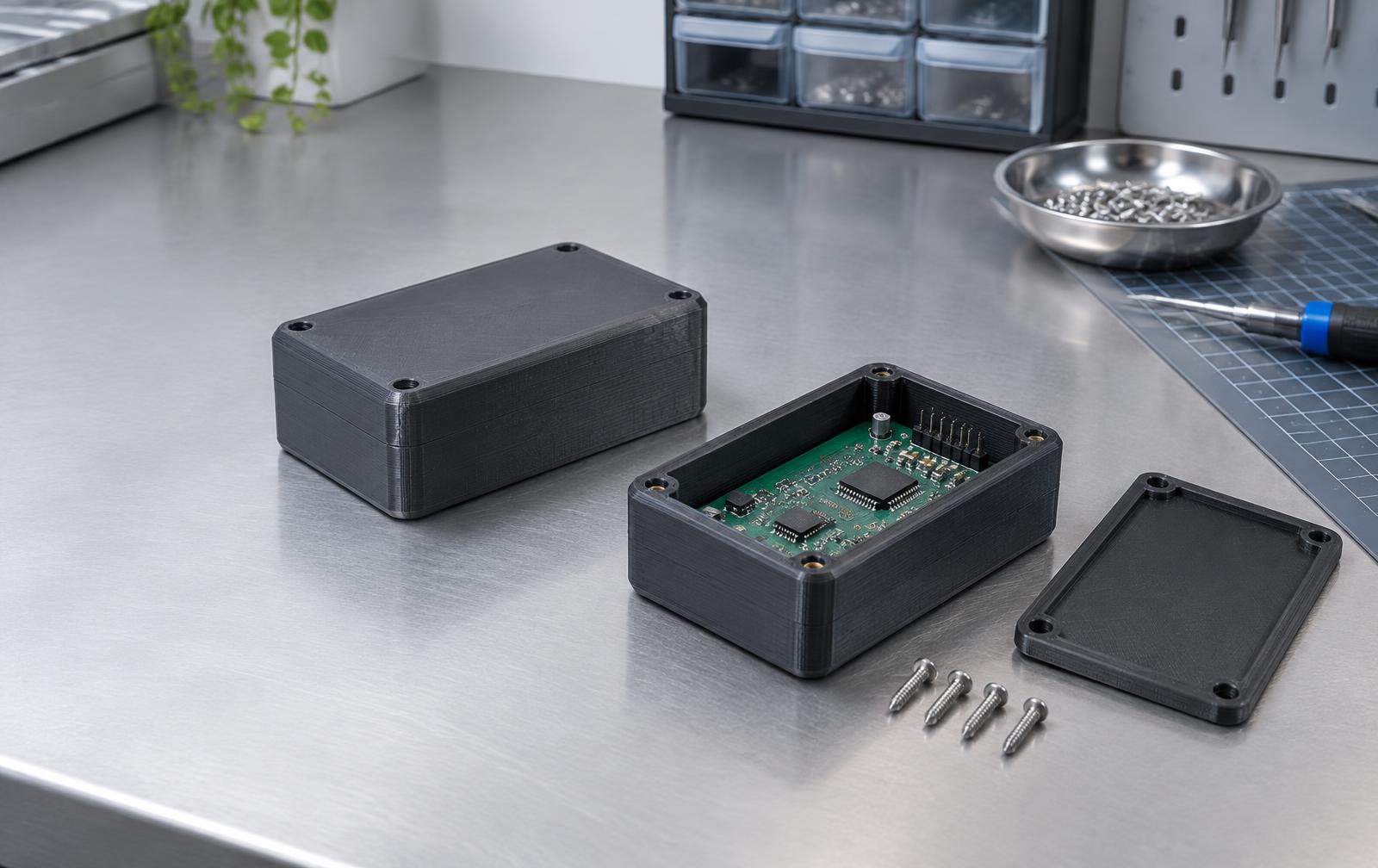
We print finished plastic parts. We don't sell ABS filament, and we don't make brake-system components.
What Is ABS 3D Printing?
ABS, short for acrylonitrile butadiene styrene, is the tough thermoplastic behind car interior trim, power tool bodies, appliance covers and LEGO bricks. We melt ABS filament through a heated nozzle and build your part layer by layer on FDM machines, in an enclosed, temperature-controlled environment that keeps it flat and the layers bonded.
The result is genuine ABS, not a look-alike. It absorbs knocks, flexes before it breaks, handles more heat than PLA, and takes drilling, tapping, sanding and paint. Its two limits: prolonged sunlight yellows and embrittles it, and the surface shows fine layer lines.
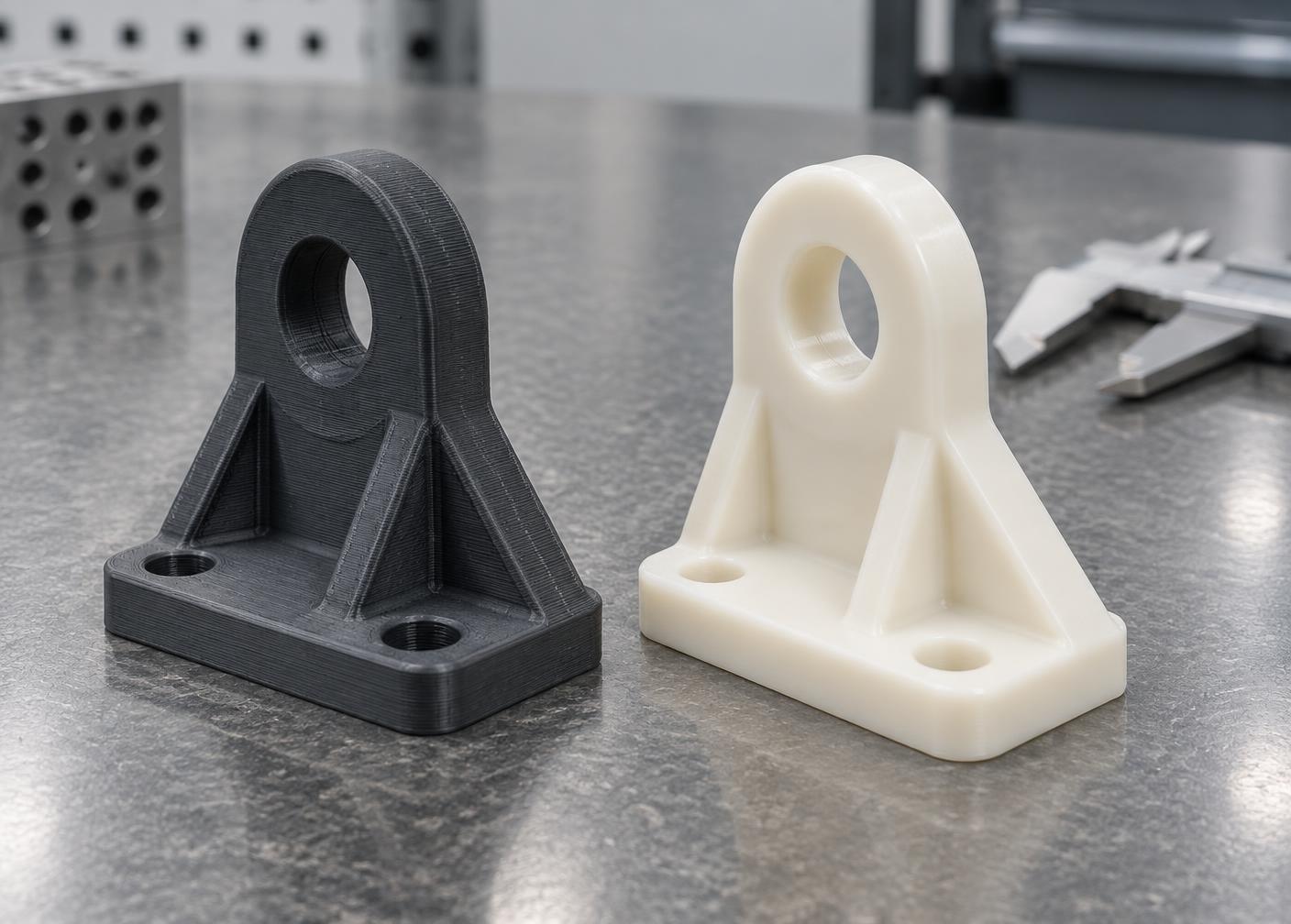
Quantix 3D Printing runs ABS 3D printing Australia-wide in two grades: standard ABS in 12 colours for fast functional prototypes, and ABS-M30i, our production grade, for larger parts and higher working temperatures. One national service, one team, shipped to every state and territory.
Four Routes to an "ABS" Part, and Only Two Are ABS
Search for ABS plastic 3D printing and you'll find resin parts sold under the same name. Useful materials, but not ABS. Resin "ABS" is a photopolymer built to imitate ABS toughness; it cures under light instead of melting, and behaves differently in heat and under load. We run both families and tell you which one you're getting.
| Route | Process | Is it ABS? | Heat rating | Surface | Max single piece | Choose it when |
|---|---|---|---|---|---|---|
| Standard ABS | FDM | Yes | ~70°C | Lightly textured, fine layer lines | 300 × 300 × 450mm | The part must be handled, assembled and tested; you want it fast and in colour |
| ABS-M30i | FDM (production grade) | Yes | ~96°C | Lightly textured, fine layer lines | 914 × 609 × 914mm | The part is large, runs warmer, or is for a food-contact application |
| ABS Resin Plastic | SLA | No, ABS-like resin | ~52°C | Ultra-smooth | 1700 × 800 × 800mm | Appearance and fine detail matter more than heat; very large presentation parts |
| Digital ABS Plus | PolyJet | No, ABS-like digital material | 49-54°C | Ultra-smooth | 490 × 390 × 200mm | Small, highly detailed design-verification models |
ABS Build Data: Envelope, Tolerance and Heat Rating
| Parameter | Standard ABS | ABS-M30i |
|---|---|---|
| Process | FDM (material extrusion) | FDM (material extrusion), production grade |
| Max build envelope | 300 × 300 × 450mm | 914 × 609 × 914mm |
| Tolerance | ±0.15mm/100mm | ±0.15mm/100mm |
| Finest detail | 1.0mm | 1.0mm |
| Min. wall thickness | 1.0mm (2mm or more for clips, bosses and load paths) | 1.0mm (2mm or more for clips, bosses and load paths) |
| Surface (as-printed) | Lightly textured, fine layer lines on curved and angled faces | Lightly textured, fine layer lines on curved and angled faces |
| Heat rating (sustained use) | ~70°C | ~96°C |
| UV / outdoor | Not UV-stable | Not UV-stable |
| Colours | Red, white, black, blue, green, orange, grey, purple, clear (translucent), pink, yellow, brown | Ivory |
| Post-processing | Drill, tap, sand, prime, paint | Drill, tap, sand, prime, paint |
| Typical dispatch | Within 24 hours of order approval | Confirmed with your quote (depends on size) |
| Delivery | Every state and territory | Every state and territory |
| CAD formats accepted | STL, STEP, IGES (most native formats convertible on request) | STL, STEP, IGES (most native formats convertible on request) |
Tolerance
±0.15mm per 100mm
Our ABS 3D printing tolerance of ±0.15mm per 100mm means a 100mm feature lands within 0.15mm of nominal, tight enough to check a moulded-part design properly: boss positions, screw clearances, lid and base engagement, PCB standoffs. Some online manufacturing networks publish ±0.3mm to ±0.5mm minimums on FDM ABS. For press fits and snap fits, allow a small design clearance; we flag anything too tight during the file check.
Size
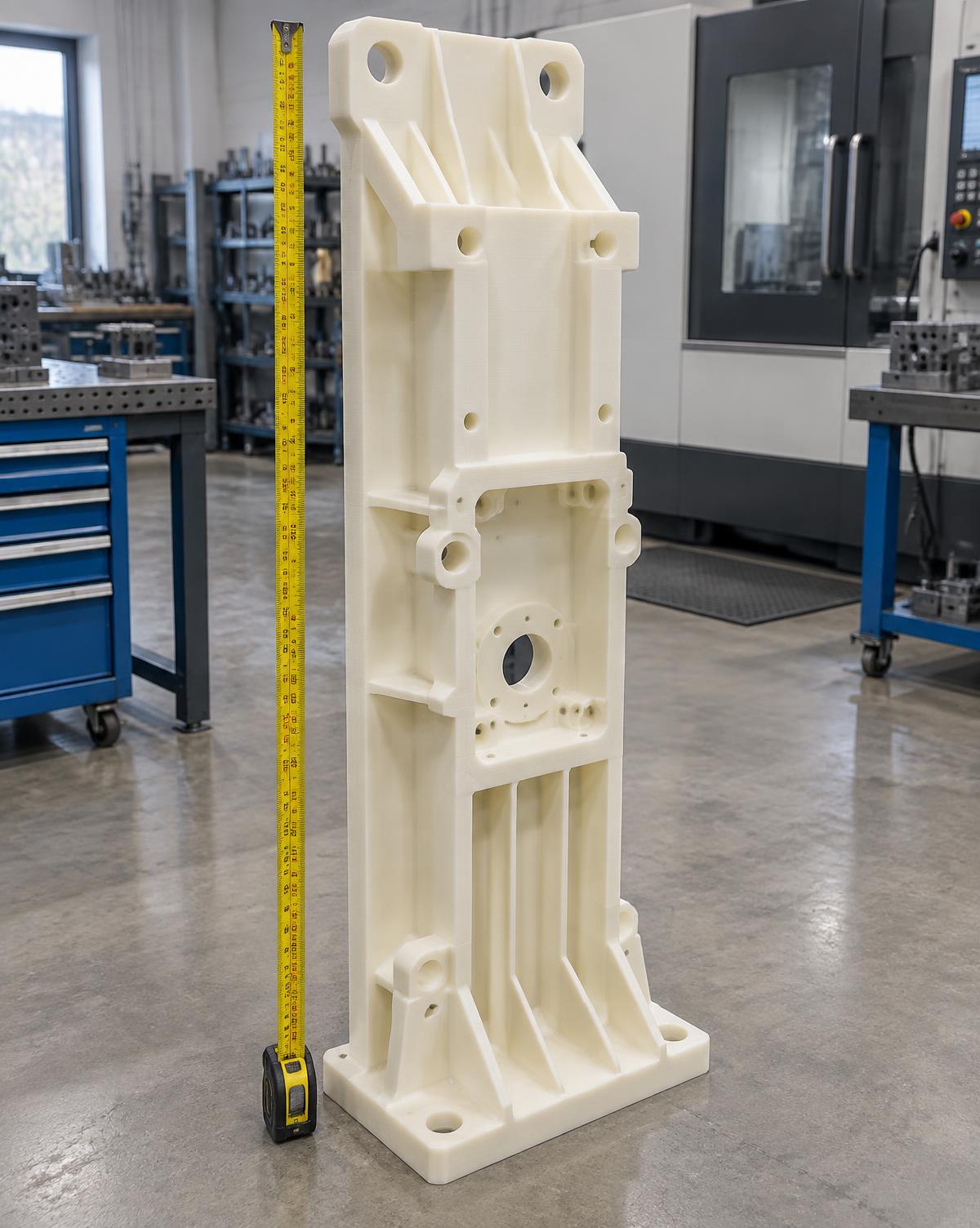
Up to 914mm in one piece
Standard ABS build size covers 450mm tall in one piece, enough for most housings, brackets and fixtures. Need more? ABS-M30i prints up to 914mm single-piece, so a full-length panel, cover or fixture base skips the splitting and bonding.
Strength direction
Oriented for the main load
Every FDM part is strongest along its layers, weakest between them. We orient each part for its main load, and flag it upfront if the geometry won't allow it.
How Much Heat Can an ABS Part Take?
- Standard ABS: rated for sustained use to about 70°C.
- ABS-M30i: about 96°C.
The plastic doesn't actually soften until nearer 100°C; the gap is deliberate headroom for load, dark colours and long hours in the heat. That's a genuine step up in ABS heat resistance over PLA, enough for most indoor and in-cabin parts. Not enough for everything an Australian summer throws at it, though.
| Where the part will live | What it faces | Standard ABS? | Our recommendation |
|---|---|---|---|
| Office, lab, workshop or factory floor | Room temperature to a hot shed day | Yes | Standard ABS |
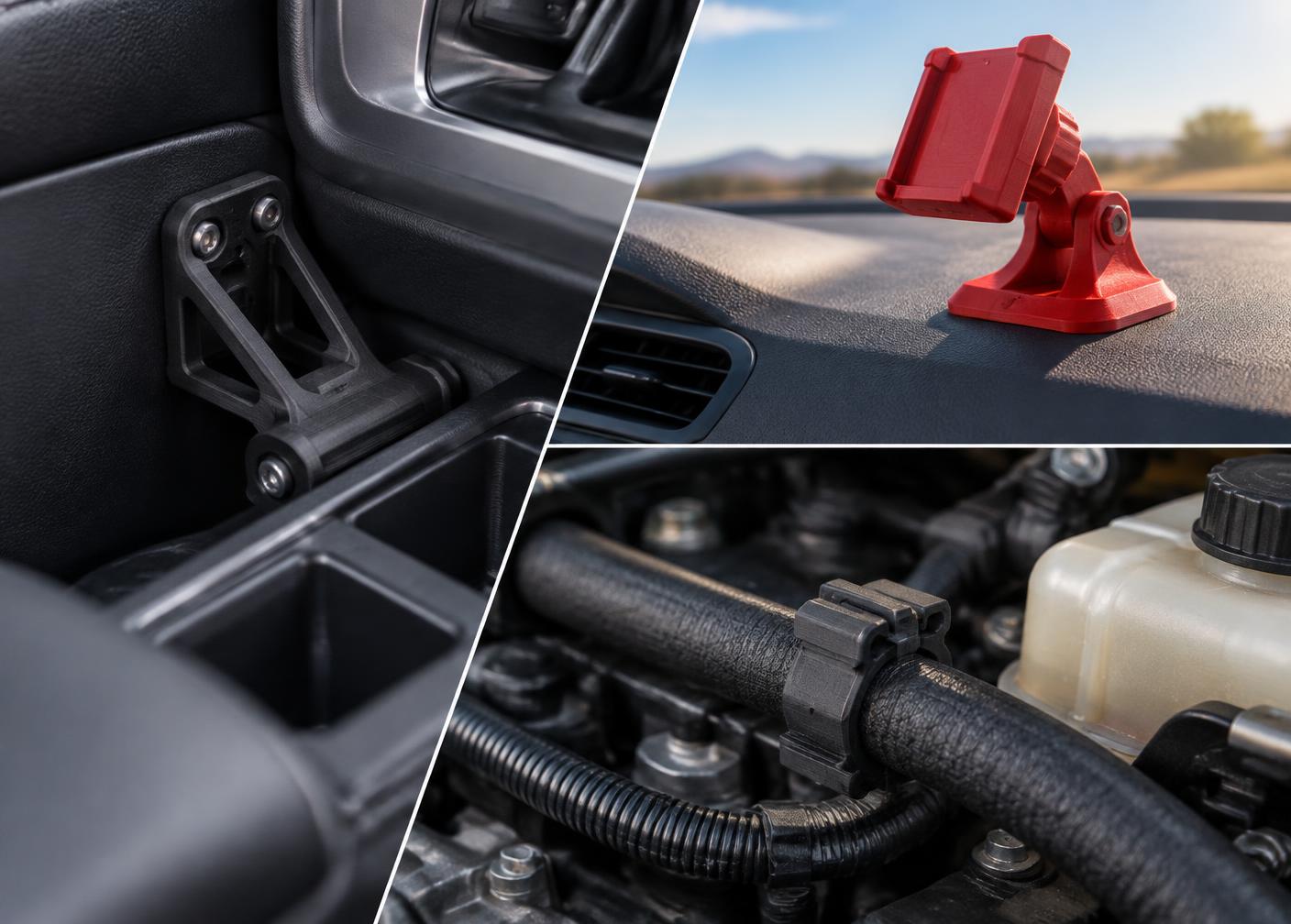
| Car cabin, shaded: console, door pocket, under-dash | Warm air on a parked summer day | Yes, in most cases | Standard ABS; ABS-M30i for extra margin |
| Dashboard top or rear parcel shelf, in direct sun | Surface temperatures that can pass 80°C, plus UV through glass | No | ASA (~98°C, UV-stable) |
| Ute tray, trailer, outdoor enclosure | Sun, UV and weather | No | ASA |
| Enclosure beside a motor or power supply, indoors | Steady warmth | Usually | ABS-M30i |
| Engine bay, near exhaust or hot fluids | Well above 100°C | No | Polycarbonate, Nylon 12 CF or ULTEM |
The Jobs ABS Does Well
Is ABS strong enough for real work? For the parts it suits, yes: it's been a production plastic for decades. Choose it when the part needs to:
- Take a knock. ABS absorbs impact and bends slightly before it fails, where PLA tends to snap.
- Clip, screw and assemble. Snap fits, screw bosses and threaded inserts behave much as they will in the moulded version, so assembly tests mean something.
- Work warm. Sustained use to about 70°C in standard ABS and about 96°C in ABS-M30i.
- Behave like production. ABS functional prototypes give test results that transfer to an injection-moulded ABS part far better than a PLA or resin stand-in.
- Be machined and finished. Drill it, tap it, sand it, prime it, paint it.
Where we'll point you to another material:
- Direct sun and weather. UV yellows and weakens ABS over months. ASA prints the same way and is UV-stable.
- Engine bays and hot machinery. Above ABS-M30i's rating, polycarbonate, Nylon 12 CF or ULTEM take over.
- Living hinges and parts that flex thousands of times. ABS will take some flex; nylon takes far more.
- Showroom surfaces. If the part will be judged on looks rather than tested, an ABS-like resin gives a smoother finish.
- Flame-rated parts. We don't list a flame-retardant ABS; ULTEM 9085 is the flame-retardant grade in our range.
ABS Beside PLA, ABS-M30i and ASA
The four FDM materials most often weighed against each other once a prototype has to do more than look right.
| PLA | Standard ABS | ABS-M30i | ASA | |
|---|---|---|---|---|
| Impact behaviour | Stiff, brittle | Tough, flexes before breaking | Tough, production grade | Tough, similar to ABS |
| Heat rating | Softens ~55-60°C | ~70°C | ~96°C | ~98°C |
| Sun / UV | Degrades | Yellows and weakens | Yellows and weakens | UV-stable |
| As-printed detail | Crisp edges | Good, fine layer lines | Good, fine layer lines | Good, fine layer lines |
| Max single piece | 300 × 300 × 450mm | 300 × 300 × 450mm | 914 × 609 × 914mm | 914 × 609 × 914mm |
| Colours | 12 | 12 | Ivory | White, black |
| Choose it for | Concept and display models indoors | Functional prototypes, enclosures, fixtures | Large or warmer parts, food-contact applications | Outdoor and sun-exposed parts |
ABS vs PLA: PLA holds sharper detail, good for early concept rounds. ABS is the step up once the part has to survive handling, assembly or warmth. See our PLA 3D printing service →
ABS vs ASA: near-identical toughness and print process, but ASA is UV-stable. Inside, ABS. Outside or under glass, ASA.
ABS vs PETG. PETG sits between PLA and ABS for heat and is popular with home printers, but it isn't part of our published FDM range. Where PETG would do the job, standard ABS usually covers it with more heat headroom, or ASA if it's outdoors.
Where ABS-M30i fits. Our production-grade ABS-M30i runs on industrial FDM equipment. Reach for it when the part is longer than 450mm, needs the extra heat margin, or is destined for a food-contact application.
For the full comparison across all 11 FDM materials, see our FDM 3D printing service →.
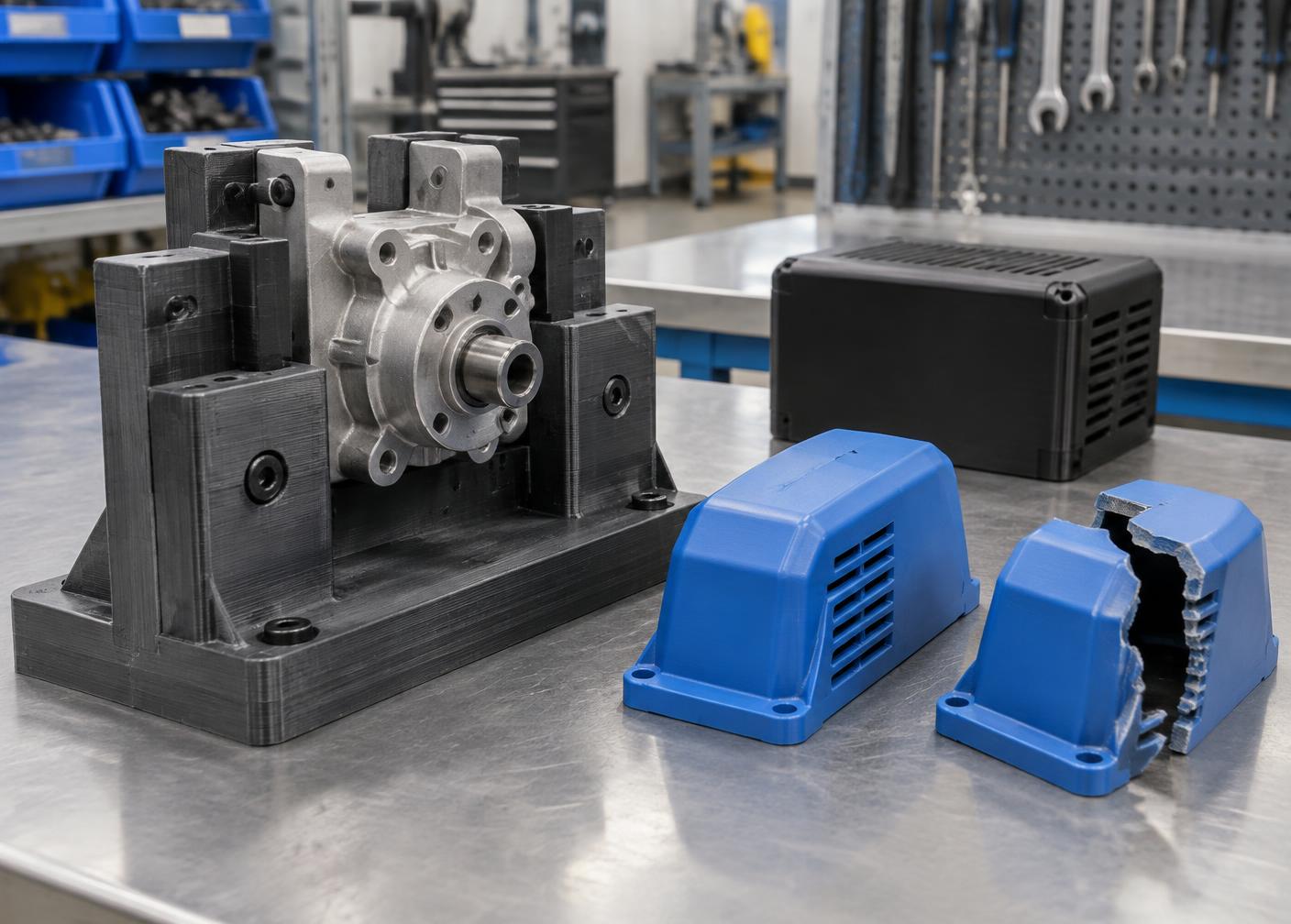
Where ABS Parts End Up
The ABS industrial applications Australia relies on all share one thing: parts that do a job, not sit on a shelf.
- Manufacturing & Engineering: ABS jigs and fixtures for assembly and inspection, machine guards and covers, cable management, and go/no-go gauges that survive being dropped on a concrete floor.
- Product Design: ABS enclosures and housings to prove screw bosses, snap-fit lids, button travel and wall stiffness before committing to an injection mould.
- Automotive & Motorsport: ABS automotive parts for interiors, including console trims, switch surrounds, vent adapters and fitment templates, with sun-facing dashboard parts moved to ASA.
- Robotics & Electronics: sensor mounts, controller housings and brackets that run warm but not hot, with ABS-M30i where the enclosure sits beside a power supply.
- Maintenance & Repair: ABS replacement parts for equipment whose original plastic components are out of production, reproduced from a CAD file, a drawing or a broken original.
- Retail, Exhibition & Events: durable display fixtures, product dummies and point-of-sale parts that are handled all day.
- Food Processing & Packaging: guides, change parts and fixtures for food-contact applications in ABS-M30i, reviewed case by case.
- Education & Research: test rigs, experimental housings and student prototypes that need to be tested rather than admired.
Most ABS prototype 3D printing we run hits the same moment in a project: the design looks right, now it has to be proven. Not sure your part fits? Send it anyway. The file review is free.
What Sets the Price of an ABS Part
ABS sits alongside PLA at the entry end of printed plastics on material cost alone, but material is rarely the biggest line in the quote. Here's what actually moves your ABS 3D printing cost Australia figure:
- 01
Machine time. Driven mostly by height and volume. A tall part takes more layers than a flat one of the same weight.
- 02
Walls and infill. Solid outer walls around an internal lattice. More walls and denser infill add strength, weight and time; we set both to suit the load.
- 03
Orientation and supports. Orienting for strength sometimes means more support material. We balance the two and flag the trade-off if it matters.
- 04
Grade. ABS-M30i runs on industrial FDM equipment and is priced accordingly; it earns its place on large or warmer parts, not every job.
- 05
Finishing. Ships as-printed by default. Sanding, priming and painting add labour.
- 06
Quantity. Several parts nested in one build cost less per part than one at a time.
Send the file for a free, itemised figure on your actual part.
Upload, Review, Dispatch
No account, no sales call and no minimum order.
- 01
Send the file.
STL, STEP or IGES, plus quantity, colour and what the part has to survive (heat, sun, load, impact). That's all an online ABS 3D printing quote needs.
- 02
We check the part, not just the file.
Walls, bosses, clearances, print orientation for strength, and whether standard ABS, ABS-M30i, ASA or a resin is the right call. If another material fits better, you'll hear it before anything prints.
- 03
Printed, inspected, dispatched.
Standard ABS leaves within 24 hours of approval; ABS-M30i dispatch is confirmed in your quote. Delivered to any address in Australia.
No account required
Get a Free ABS Quote
Upload your CAD file through the quote form with the quantity, colour and the conditions the part will face. Our team follows up directly if anything in the design is worth flagging first.
- Standard ABS or ABS-M30i
- Free engineering file check
- 24-hour dispatch on standard ABS
- No minimum quantity or value
Common ABS Questions
What is ABS 3D printing?
FDM printing with acrylonitrile butadiene styrene, a tough thermoplastic widely used in moulded products. Filament is melted and deposited layer by layer in a temperature-controlled environment. The finished parts take impact, handle more heat than PLA and can be drilled, tapped, sanded and painted, which is why ABS is a common choice for functional prototypes, enclosures and fixtures.
Is ABS resin the same as ABS?
No. ABS-like resins used in SLA and PolyJet printing are photopolymers formulated to imitate ABS toughness. They give a smoother surface and very fine detail, but they have lower heat ratings (around 50°C) and behave differently under load. Our FDM ABS and ABS-M30i are true ABS thermoplastic. If a drawing just says "ABS", tell us how the part will be used and we'll confirm which you need.
How heat resistant are your ABS parts?
Standard ABS: sustained use to about 70°C. ABS-M30i: about 96°C. The plastic itself doesn't soften until nearer 100°C; the margin covers load, dark colours and long exposure.
Will ABS melt in a car?
It won't melt, and in the cabin (console, door pockets, under the dash) it generally holds its shape. Parts sitting on the dashboard top or rear shelf in direct sun can pass 80°C and also take UV through the glass, so those should be printed in ASA.
Can ABS parts be used outdoors?
Not for long-term exposure. Sunlight yellows ABS and makes it brittle over time. ASA prints much like ABS, is UV-stable and handles about 98°C, so it's the material we recommend for outdoor and sun-exposed parts.
Is ABS strong enough for functional parts?
Yes, for most functional prototypes, enclosures, brackets and fixtures. ABS absorbs impact and flexes slightly before breaking. Like all FDM parts, it is weaker between layers than along them, so we orient each part for its main load. For heavy loads, high heat or constant flexing, polycarbonate or nylon is the better choice.
What's the difference between ABS and PLA?
PLA prints sharper detail and suits early concept models, but it is brittle and softens from roughly 55-60°C. ABS is tougher, rated to about 70°C, and behaves much more like a moulded production part. Choose PLA to see the design and ABS to test it.
What's the difference between ABS and ASA?
They print in a similar way and share similar toughness. ASA is UV-stable and rated to about 98°C, so it is the right choice for anything outdoors or under glass. For indoor parts, ABS offers 12 colours and 24-hour dispatch.
Do you print PETG?
PETG isn't part of our published FDM range. For most parts where PETG would be used, standard ABS covers the need with more heat headroom, or ASA if the part lives outside.
What is ABS-M30i?
ABS-M30i is a production-grade ABS printed on industrial FDM equipment. In our range it offers a larger single-piece envelope (914 × 609 × 914mm), a higher heat rating (about 96°C) and suitability for food-contact applications. It is printed in ivory.
Is ABS food safe?
Standard ABS isn't a food-contact grade and we don't recommend it for food or drink contact. ABS-M30i is the food-contact grade in our range. Even then, FDM layer lines can trap residue, so tell us how the part will be cleaned and we'll advise on design and finishing.
Do you offer ESD-safe or flame-retardant ABS?
Neither is in our published range. For flame-retardant parts, ULTEM 9085 is the flame-retardant grade we print. If your application needs static-dissipative properties, contact us with the requirement and we'll advise on options.
Can ABS parts be smoothed or painted?
Yes. ABS sands, primes and paints well, and it is the FDM plastic that responds to solvent vapour smoothing for a glossy, sealed surface. Tell us the finish you need with your file and we'll confirm the options for your part in the quote.
How accurate are your ABS prints?
Tolerance is ±0.15mm per 100mm on both standard ABS and ABS-M30i, with finest detail of 1.0mm and a minimum wall of 1.0mm. Allow a small clearance on mating parts and we'll flag any fits that look too tight.
What's the largest ABS part you can print?
300 × 300 × 450mm in standard ABS, and up to 914 × 609 × 914mm in one piece in ABS-M30i.
What colours can you print in ABS?
Standard ABS comes in 12 colours: red, white, black, blue, green, orange, grey, purple, clear (translucent), pink, yellow and brown. ABS-M30i is printed in ivory. Each part prints in one colour, and parts can be painted to a specified finish on request.
How much does ABS 3D printing cost?
It depends on machine time (mostly height and volume), wall and infill settings, orientation and supports, grade, finishing and quantity. Upload your file for a free, itemised quote on your exact part.
How fast can I get ABS parts?
Standard ABS parts are dispatched within 24 hours of order approval. ABS-M30i dispatch depends on part size and is confirmed in your quote. Delivery time then depends on your location and shipping option.
Is there an ABS 3D printing service near me?
There's no need to find a printer in your suburb. Quantix 3D Printing runs one national service, so instead of searching for ABS 3D printing near me, upload your file from any state or territory and the finished parts are delivered to your door.
Is there a minimum order?
No minimum quantity and no minimum order value. A single bracket is quoted the same way as a batch of two hundred.
Are my files kept confidential?
Yes. Every file and project detail stays private.
Do you sell ABS filament?
No. We print finished parts from your files. For filament spools, an Australian filament retailer is the right place to look.
How do I get an ABS quote?
Upload your CAD file through the quote form with the quantity, colour and the conditions the part will face. Our team follows up directly if anything in the design is worth flagging first.
Send Us the Part That Has to Survive the Test Rig
True ABS. ±0.15mm per 100mm. 12 colours. Up to 914mm in one piece. This is the ABS 3D printing company Australia engineering and product teams turn to when a prototype has to be proven, not just presented. One enclosure or a production run of custom ABS 3D printing, upload the file for a free quote and a straight answer on whether ABS is the right plastic for it. Order ABS parts online from any state or territory, no minimum, no lock-in.