
PLA · FDM · 24-hour dispatch
PLA 3D Printing Service
Concept models on your desk tomorrow, not next week. Quantix 3D Printing turns your CAD file into PLA 3D printed parts held to ±0.15mm per 100mm, in any of 12 colours, dispatched within 24 hours of approval. An engineer checks every file before it prints, including whether PLA is the right plastic for the job at all.
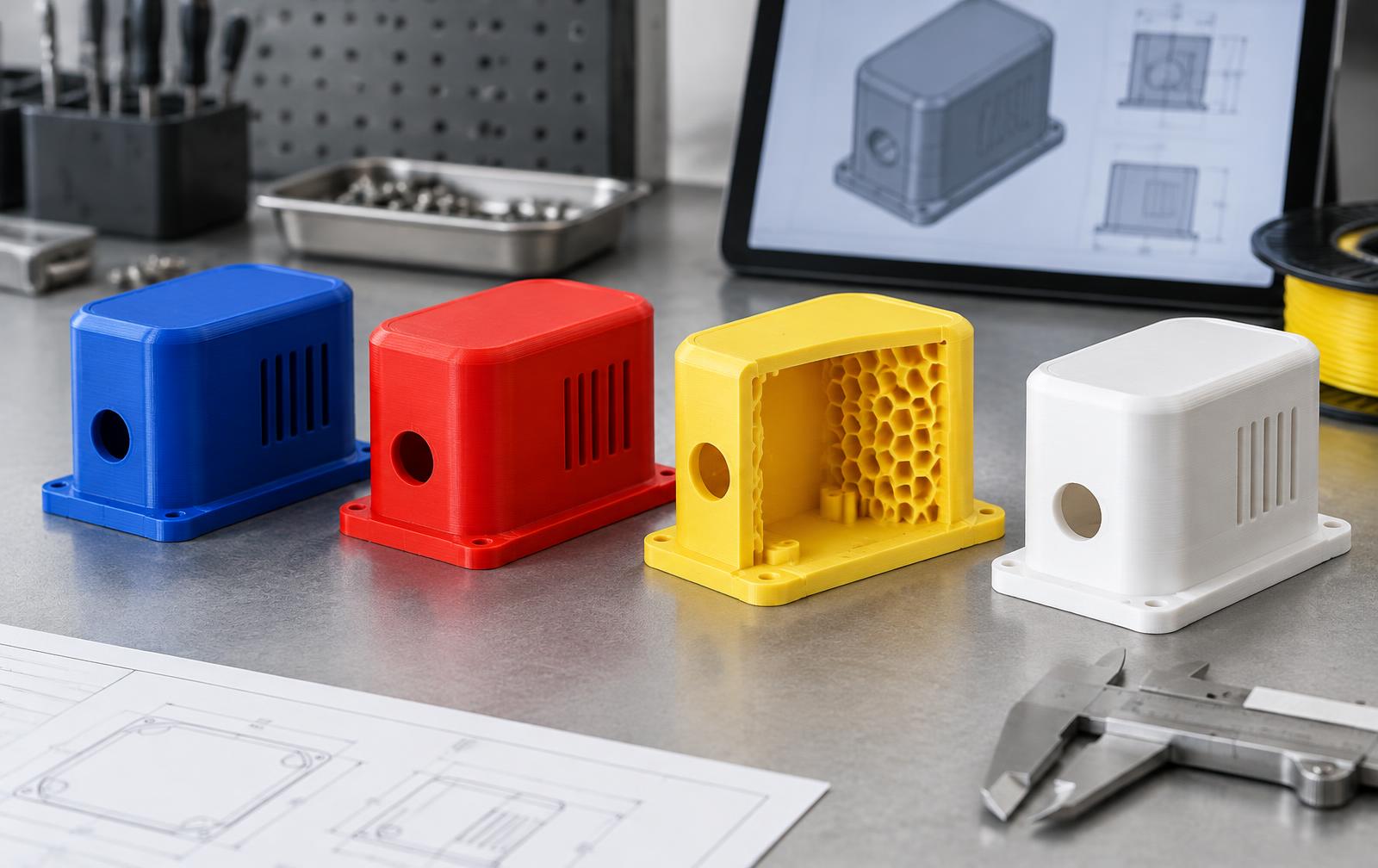
We print finished parts. Looking for PLA filament spools? We don't sell them.
The material, plainly explained
What Is PLA 3D Printing?
PLA, short for polylactic acid, is a rigid thermoplastic made from plant sugars such as corn starch or sugarcane. In PLA printing, a filament of this plastic is melted through a heated nozzle and laid down line by line, layer by layer, on an FDM (fused deposition modelling) machine until the part is complete. It prints with very little warping or shrinkage, holds sharp edges and flat faces well, and comes in a wide range of colours, which is why it is the default choice for concept models, fit checks and display parts. Its limits are just as clear: PLA is stiff but brittle under impact, and it starts to soften at temperatures you can find inside a closed car on a summer day.
Quantix 3D Printing runs a PLA 3D printing service Australia product and engineering teams use for the first, second and tenth version of a design: fast enough to iterate on daily, accurate enough to check a fit, and quoted from one national service with parts shipped to every state and territory.
PLA Specifications: Size, Accuracy and Finish
- Process
- FDM (material extrusion): PLA filament melted through a heated nozzle and deposited layer by layer
- Max build envelope
- 300 × 300 × 450mm (single piece); larger parts split and joined, or moved to an engineering-grade FDM material with a 914 × 609 × 914mm envelope
- Tolerance
- ±0.15mm/100mm
- Finest detail
- 1.0mm
- Min. wall thickness
- 1.0mm; 2mm or more recommended for parts that will be handled
- Surface finish (as-printed)
- Lightly textured, with fine visible layer lines on curved and angled faces
- Support structures
- Printed alongside the part and removed by hand; supported faces may show light marks
- Heat
- Sustained service below ~50°C recommended; softening begins ~55–60°C
- Colours
- Red, white, black, blue, green, orange, grey, purple, clear (translucent), pink, yellow, brown (12 standard)
- Best suited to
- Concept models, fit checks, display and presentation parts, light-duty fixtures
- Not suited to
- Heat, sustained load, impact, outdoor exposure, food contact
- Typical dispatch
- Within 24 hours of order approval
- Delivery
- Every state and territory
- CAD formats accepted
- STL, STEP, IGES (most other native formats convertible on request)
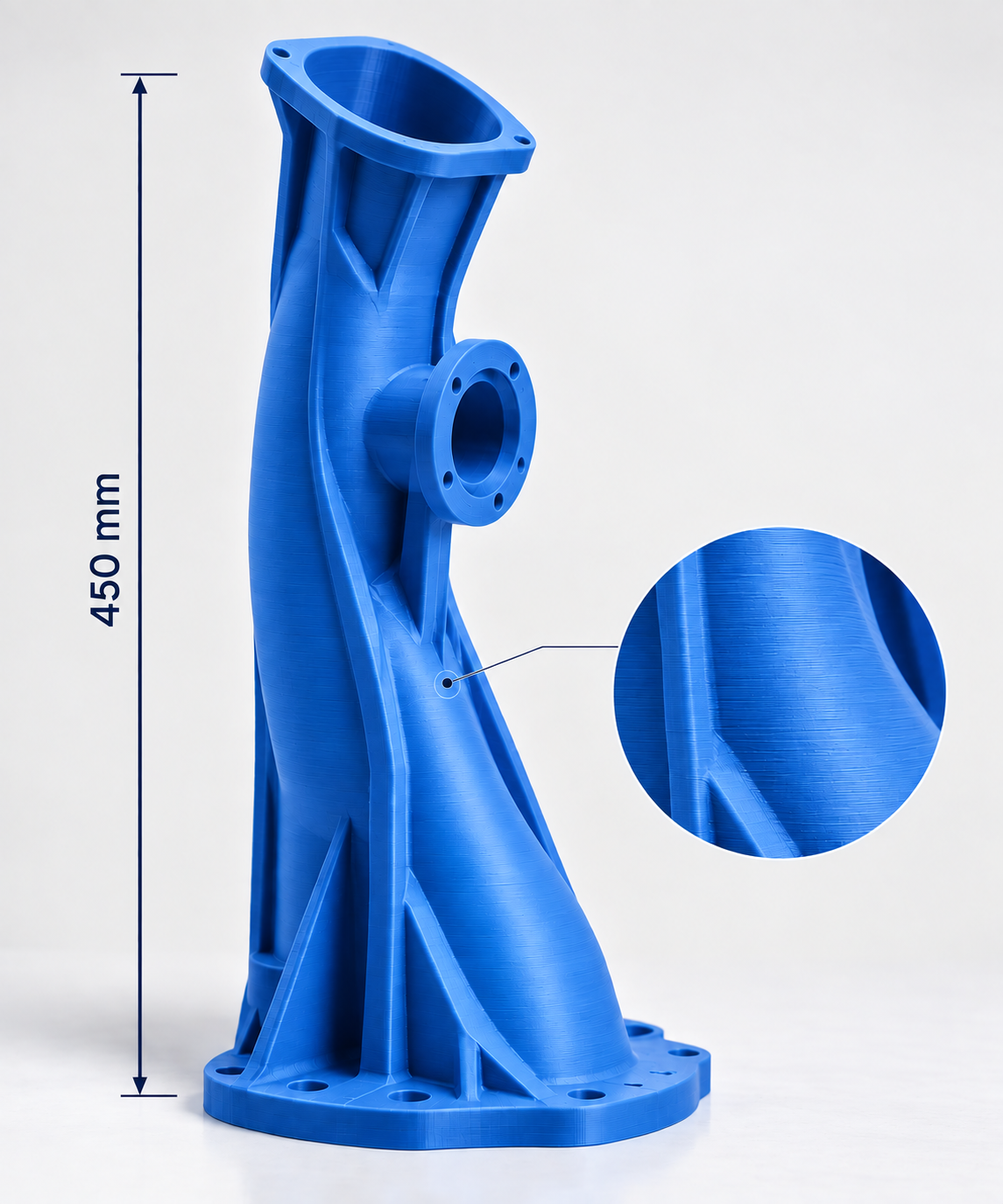
On tolerance. ±0.15mm per 100mm means a 100mm feature lands within 0.15mm of nominal, which is ample for checking whether a PCB drops into a housing or two halves close cleanly. For press fits, design a small clearance rather than relying on line-to-line dimensions; we'll flag any mating features that look too tight when we check the file. That level of PLA 3D printing tolerance is tighter than the ±0.5mm published by some Australian providers, and it holds across all 12 colours.
On height. The 450mm build height is taller than most desktop-class PLA services, so tall, slender parts such as architectural towers, display stands and full-length handles can often print in one piece without a visible join.
Choosing PLA for the Right Reasons
Most PLA mistakes aren't printing mistakes. They're material mistakes: a bracket that sagged on a hot dashboard, a clip that snapped on the first flex. Here is how we decide.
PLA is a strong choice when the part needs to:
- Look and fit right. Crisp edges, flat faces and minimal warping make PLA dependable for checking form, proportion, hole positions and mating features.
- Be held and handled indoors. Stiffness is genuinely high for a printed plastic; a well-designed part with 2mm walls feels solid in the hand.
- Arrive fast and in colour. Short print times, 24-hour dispatch and 12 colours suit design reviews, client presentations and multi-version comparisons.
- Stay at room temperature. Offices, studios, classrooms, climate-controlled workshops.
Where we'll steer you away from PLA:
- Anything that gets warm. On the question of PLA heat resistance, the honest answer is modest. Standard PLA begins to soften from roughly 55–60°C and creeps under load below that. A car parked in an Australian summer, a shed in February, a sunny windowsill, or an enclosure next to a motor or power supply can all get there.
- Anything that takes a hit or a repeated flex. PLA is stiff but brittle. Snap fits, clips and living hinges tend to crack rather than bend.
- Anything that lives outside. UV and moisture degrade PLA over time.
- Anything that holds food or drink. Layer lines trap residue, and standard PLA isn't a food-contact grade.
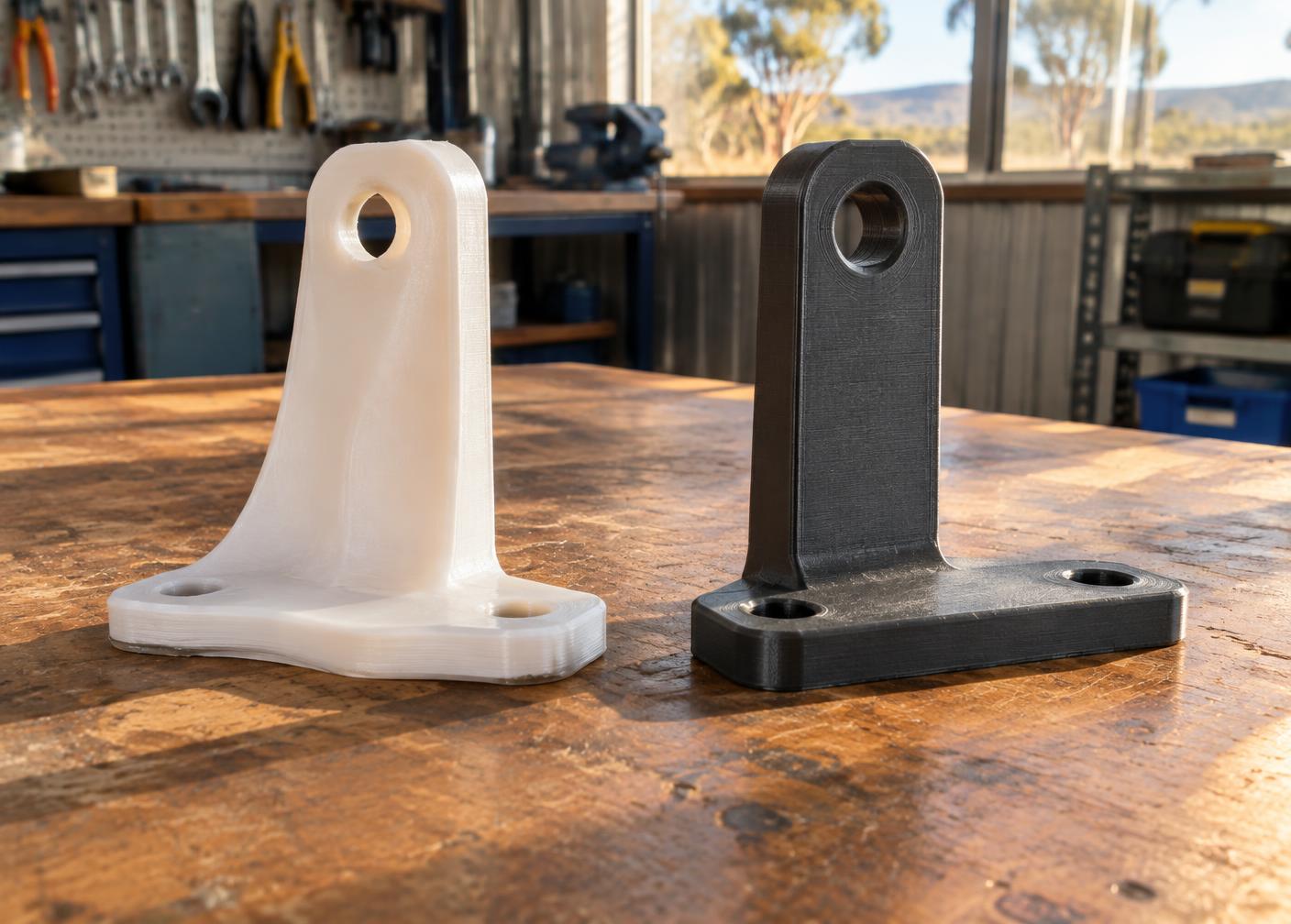
So, is PLA strong enough? For appearance, fit and gentle handling at room temperature, yes. For heat, impact or real load, step up to ABS, ASA, polycarbonate or nylon from our FDM range, and we'll say so when we review your file rather than after the part fails.
12 stocked choices
Twelve Colours, Kept in Stock
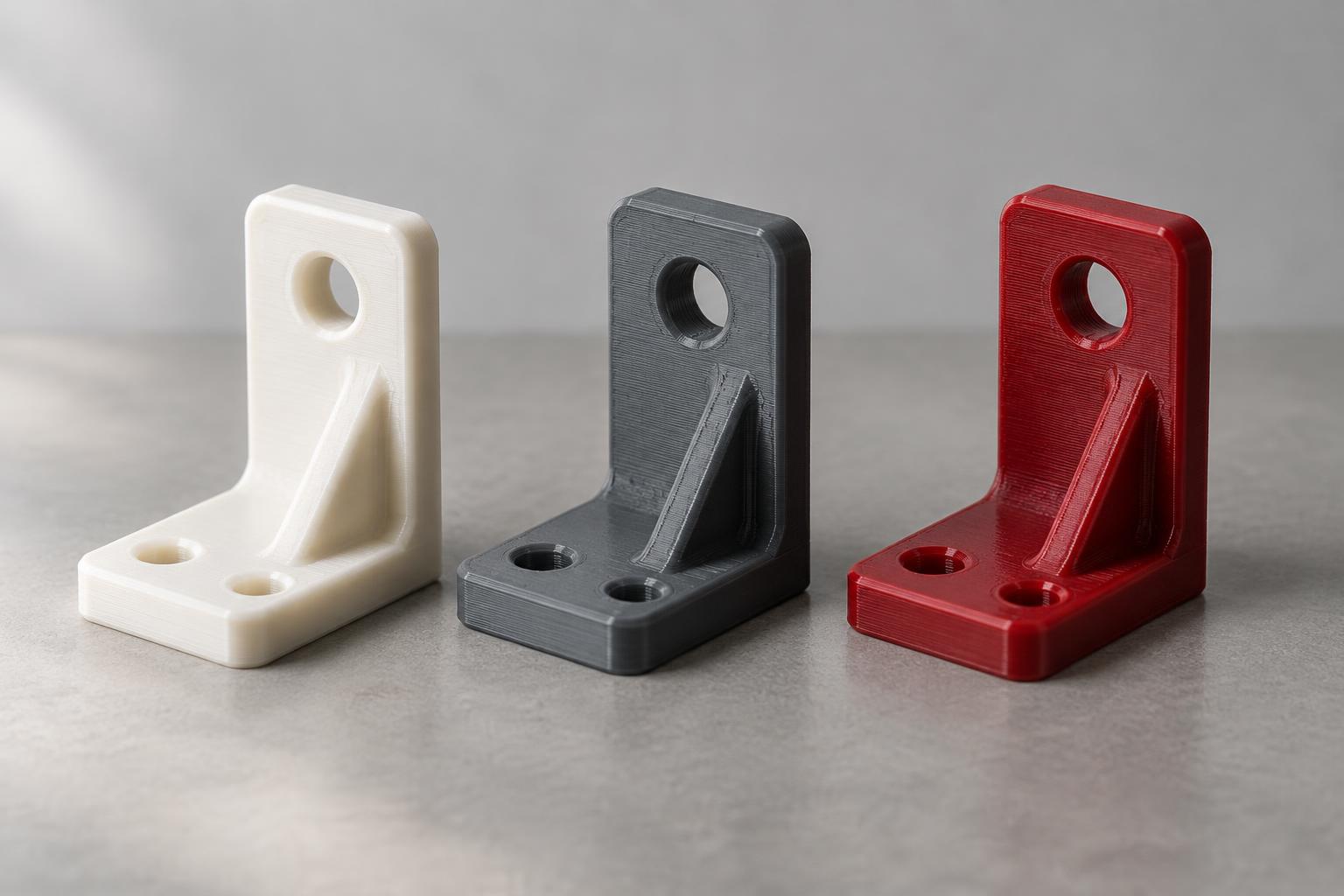
PLA 3D printing materials in our range mean one standard grade in twelve colours, rather than a shelf of branded blends. That keeps results repeatable: the part you approve in grey behaves the same way when you reorder it in blue.
Coloured PLA prints save a painting step when the goal is distinguishing parts rather than matching a brand swatch exactly: colour-coding the components of an assembly, showing zones on a site model, or presenting three design options side by side. Each part prints in a single colour. The clear option is translucent rather than glass-clear, which suits light pipes and "see the internals" concept models but not optical lenses.
Need an exact brand colour? We can sand, prime and paint PLA to a specified finish; mention it with your file and we'll include it in the quote.
PLA Against the Next Step Up
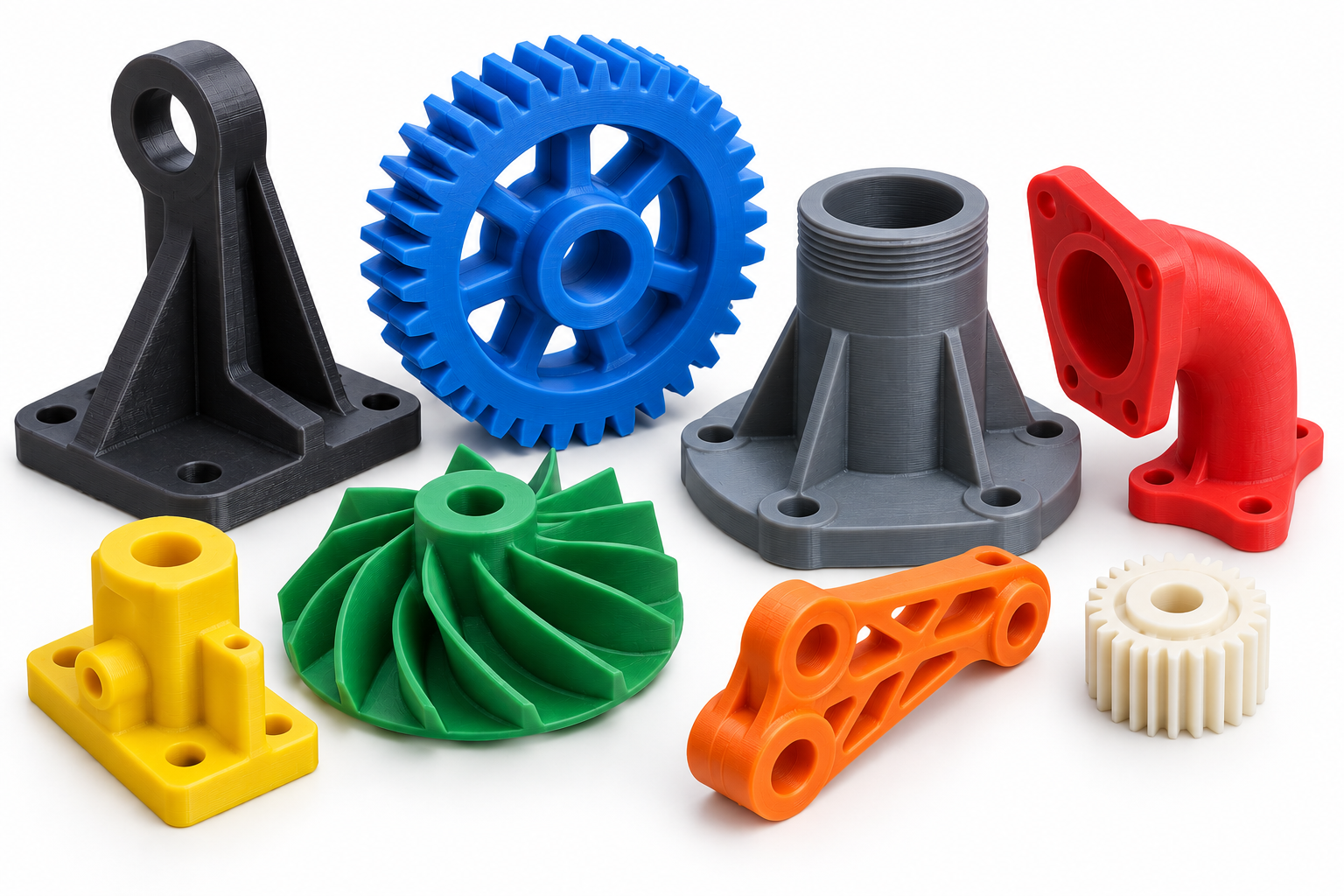
These are the three FDM materials most often weighed against each other for a first print. Figures are from our FDM range.
| PLA | ABS | ASA | |
|---|---|---|---|
| Strength in use | Stiff, brittle under impact | Tougher, takes knocks better | Similar to ABS |
| Heat | Softens ~55–60°C | ~70°C | ~98°C |
| Outdoor / UV | Degrades | Yellows and weakens in sun | UV-stable |
| Surface detail | Crisp edges, minimal warping | Good | Good |
| Max build (our range) | 300 × 300 × 450mm | 300 × 300 × 450mm | 914 × 609 × 914mm |
| Choose it for | Concept, fit and display parts indoors | General-purpose functional prototypes | Outdoor and sun-exposed parts |
PLA vs ABS comes down to heat and handling: if the part will be dropped, flexed or left somewhere warm, ABS earns its place. ASA is the answer when it's going outside.
On PLA vs PETG. PETG sits between PLA and ABS for toughness and heat, and it's popular with home printers. It isn't part of our published FDM range; for parts where you'd reach for PETG, ABS or ASA usually covers the same need with more heat headroom. Tell us what the part has to survive and we'll recommend the fit.
For the full comparison across all 11 FDM materials, including polycarbonate, nylon and ULTEM, see our FDM 3D printing service .
What Australian Teams Print in PLA
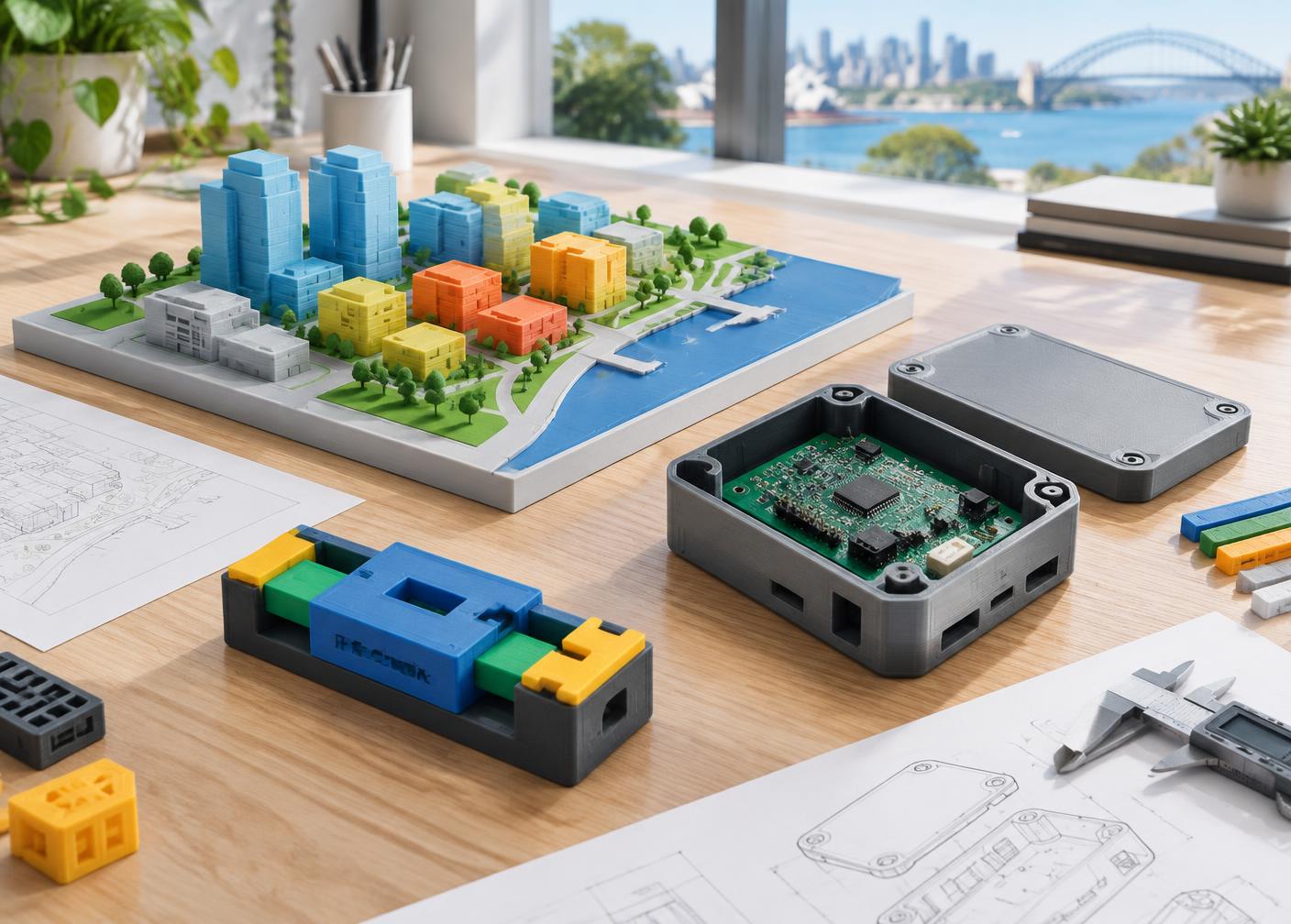
Across the PLA industrial applications Australia relies on, one pattern holds: PLA supports the work rather than doing the work. It proves a design, guides a process or presents a result, then hands over to an engineering plastic for anything that has to survive service conditions.
- Manufacturing & Engineering: fit-check prototypes before committing to an engineering plastic or a mould, drilling and marking templates, go/no-go visual gauges, and light-duty jigs used at room temperature.
- Product Design: early PLA concept models for form and proportion reviews, printed in several colours so options can be compared side by side on the same table.
- Architecture & Design: PLA architectural models at site and building scale, with colour-coded massing and tall elements printed in one piece up to 450mm.
- Automotive & Motorsport: interior trim mock-ups, packaging studies and fitment templates, used in the workshop rather than left in a parked car.
- Robotics & Electronics: enclosure and housing concepts to test PCB fit, button placement and cable routing before moving to ABS or nylon.
- Retail, Exhibition & Events: display stands, product dummies, signage elements and point-of-sale props for indoor use.
- Education & Research: teaching models, test rigs and experimental housings where fast iteration matters more than long service life.
These PLA prototypes Australia teams order most often share one thing: they need to look right and fit right quickly, then make way for the production material. Not sure your part belongs in that group? Send it anyway; the review is free.
PLA 3D printing Australia wide: the same colours, the same tolerance and the same 24-hour dispatch whether your parts go to a Melbourne studio, a Perth workshop or a regional address, with no city-by-city pricing.
How a PLA Quote Is Built
PLA is the entry point on cost for printed plastic, but two parts of the same size can still be quoted quite differently. Here's what moves the number:
- 01
Print time, driven mostly by height and volume. A tall part takes more layers and more hours than a flat one of the same weight.
- 02
Walls and infill. The inside of a PLA print is a lattice, not solid plastic. More walls and denser infill add strength and weight, and time with them. We set both to suit what the part has to do, and tell you if we'd change them.
- 03
Supports. Overhangs need printed supports, which add material and removal time. Sometimes a small change in orientation or a chamfer instead of a flat overhang removes most of them.
- 04
Finishing. Parts ship as-printed by default. Sanding, priming and painting add labour.
- 05
Quantity. Several parts nested onto one build plate cost less per unit than the same parts run one at a time.
Why not just a price per gram? Makerspace rate cards often charge by weight, and that's a fair model for self-service printing. It misses what actually costs time on a production job: machine hours, support removal, an engineer checking your file and a quality check before dispatch. That's why your PLA 3D printing cost Australia quote is priced on the specific geometry, not a flat rate. A PLA 3D printing price per gram figure alone will look lower than a bureau quote and include much less.
Send the file for a free, itemised figure on your actual part.
Three Steps from File to Parcel
Online PLA printing with no account to create, no sales call to sit through and no minimum order to reach.
- 01
Upload your file.
STL, STEP or IGES, plus the colour, quantity and anything the part needs to survive. No account needed for an online PLA 3D printing quote.
- 02
An engineer checks it.
Wall thickness, overhangs, fits and, most importantly, whether PLA suits the job. If another material from our range would serve you better, you'll hear that before anything prints.
- 03
Printed, checked and dispatched within 24 hours of approval.
Delivered to any address in Australia.
No account required
Get a Free PLA Quote
Upload your CAD file through the quote form with the colour, quantity and any conditions the part will face. Our team follows up directly if anything in the design is worth flagging first.
- Twelve stocked colours
- Free engineering file check
- Within 24 hours of order approval
- No minimum quantity or value
PLA Printing Questions, Answered
What is PLA 3D printing?
PLA 3D printing is FDM printing with polylactic acid, a rigid plant-derived thermoplastic. The filament is melted through a heated nozzle and deposited layer by layer to build the part. It's valued for accuracy, low warping and colour range, and is typically used for concept models, fit checks and display parts.
Is PLA strong enough for my part?
For parts that need to look right, fit right and be handled gently at room temperature, yes. PLA is stiff, but brittle under impact, and it softens with heat. For clips, snap fits, load-bearing brackets or anything that gets warm, ABS, ASA, polycarbonate or nylon is the better choice, and we'll recommend one when we check your file.
Will PLA melt in a car?
It won't melt, but it will soften and deform. Standard PLA begins to lose stiffness from roughly 55–60°C, and a closed car parked in the Australian sun can exceed that on a warm day. Dashboard mounts, phone holders and anything else that lives in a vehicle should be printed in ASA or polycarbonate instead.
What is the difference between PLA vs PETG?
PETG is tougher and more heat tolerant than PLA, with a little more flex. PLA holds sharper detail and warps less. PETG isn't part of our published FDM range; where a part calls for it, ABS or ASA usually covers the same need with more heat headroom.
Do you print PLA+?
PLA+ is a retail label for modified PLA blends and isn't a single standard. If your drawing specifies PLA+ or a particular brand of tough PLA, note it with your file and we'll confirm what we can match. If the goal is more toughness, ABS or ASA is often the more reliable route.
Is PLA biodegradable?
Only under industrial composting conditions, with sustained heat and humidity. In a backyard compost, landfill or the ocean it breaks down very slowly. PLA is made from renewable plant sources, which is a genuine benefit, but it shouldn't be treated as a plastic that simply disappears.
Is PLA food safe?
We don't recommend FDM-printed PLA for food or drink contact. Layer lines trap residue that is hard to clean, and standard PLA isn't certified as a food-contact grade. For food-contact applications, ask us about ABS-M30i, the food-contact grade in our FDM range.
Can PLA parts be used outdoors?
Not for long. UV light and moisture degrade PLA over time, and summer heat softens it. ASA is the UV-stable FDM material in our range and the usual choice for outdoor parts.
How accurate are your PLA prints?
Tolerance is ±0.15mm per 100mm, with finest detail of 1.0mm and a minimum wall of 1.0mm. For mating parts, design a small clearance and we'll flag any fits that look too tight.
What's the largest PLA part you can print?
300 × 300 × 450mm in one piece. Larger parts can be split and joined, or printed in one piece in an engineering-grade FDM material with a 914 × 609 × 914mm envelope.
What colours can you print in PLA?
Twelve: red, white, black, blue, green, orange, grey, purple, clear (translucent), pink, yellow and brown. Each part prints in one colour, and parts can be painted to a specified finish on request.
How much does PLA 3D printing cost?
It depends on print time (mostly height and volume), wall and infill settings, supports, finishing and quantity. Upload your file for a free quote on your exact part.
How fast can I get PLA parts?
We dispatch within 24 hours of order approval. Delivery time then depends on your location and shipping option.
Is there a PLA 3D printing service near me?
You don't need a walk-in printer down the road. Quantix 3D Printing runs one national service, so rather than searching for PLA 3D printing near me, upload your file from any state or territory and the finished parts come to your door.
Is there a minimum order?
No minimum quantity and no minimum order value. One part is quoted the same way as a hundred.
Are my files kept confidential?
Yes. Every file and project detail stays private.
Do you sell PLA filament?
No. We print finished parts from your files. For filament spools, an Australian filament retailer is the right place to look.
How do I get a PLA quote?
Upload your CAD file through the quote form with the colour, quantity and any conditions the part will face. Our team follows up directly if anything in the design is worth flagging first.
Put Your Next Design Iteration on the Table Tomorrow
Twelve colours, ±0.15mm per 100mm, up to 450mm tall and dispatched within 24 hours: Quantix 3D Printing is the PLA 3D printing company Australia design and engineering teams use to move from screen to hand without waiting a week. Whether it's one concept model or a run of custom PLA 3D printing for a client presentation, upload the file for a free quote and a straight answer on whether PLA is the right material for it. Order PLA parts online from any state or territory, with no minimum and no lock-in.